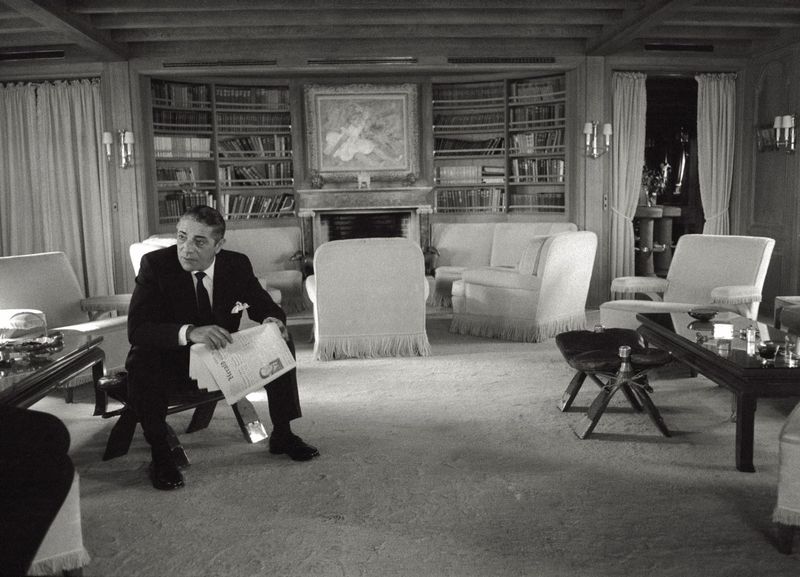
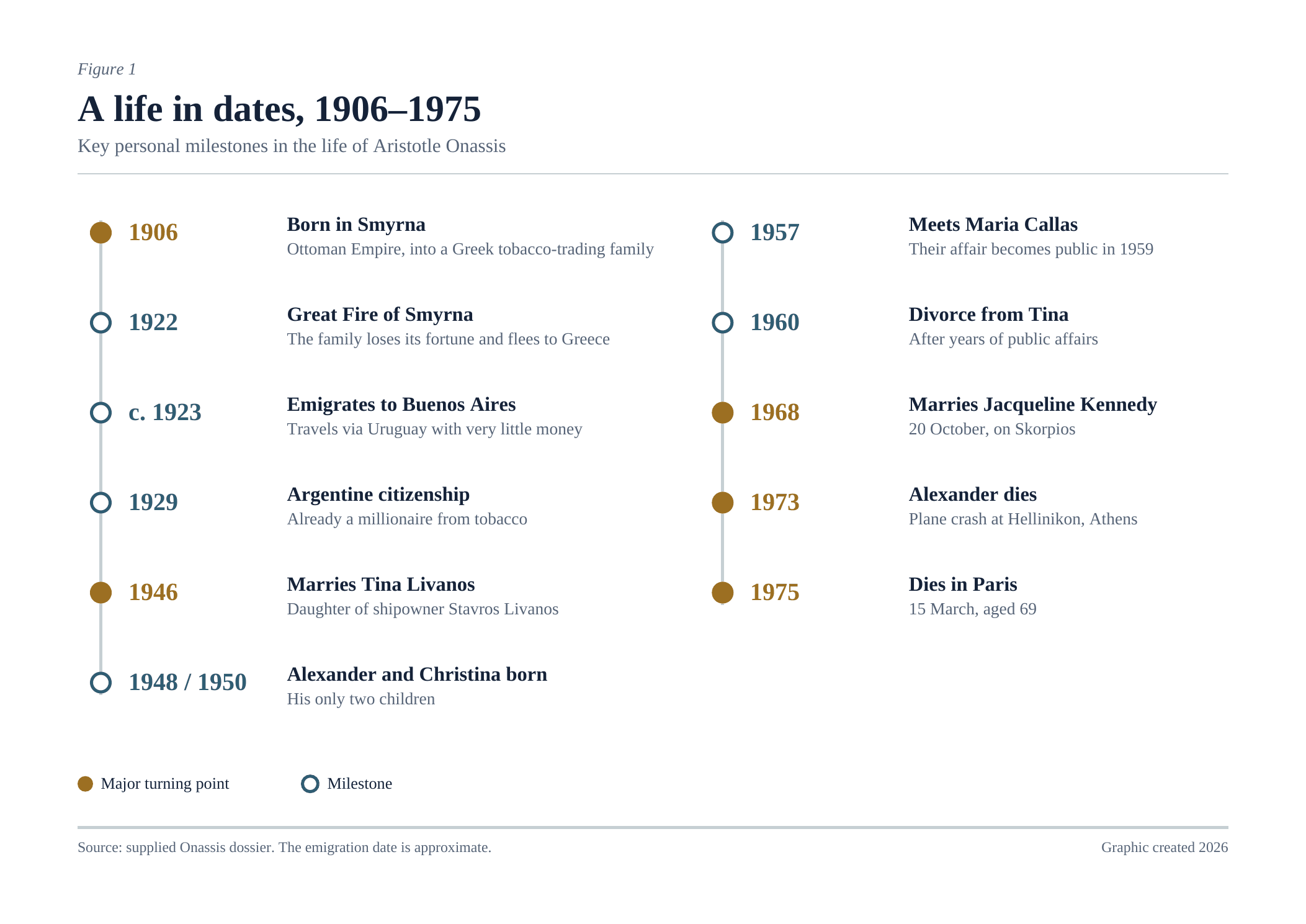
Aristotle Socrates Onassis was born on 20 January 1906 in Smyrna, today's Izmir, into a comfortable Greek merchant family. His father traded tobacco, and the boy grew up expecting a life of relative ease. The Greco-Turkish War ended that. The Great Fire of 1922 destroyed the city's Greek quarter, and the family lost most of what it owned, arriving in Greece as refugees.
At sixteen or seventeen he left for Argentina with very little money, travelling via Uruguay. In Buenos Aires he took whatever work he could find: dishwasher, laundry helper, electrician. His steadiest job was the night shift on the switchboard of the British United River Plate Telephone Company, which left his days free to trade.
Key Takeaways:
Born in Smyrna in 1906, he watched his family lose almost everything in 1922, then rebuilt from scratch in Argentina, first through tobacco.
Shipping made him. Six second-hand freighters bought in the Depression grew into a flag-of-convenience fleet of about 60 vessels by the mid-1950s, anchored by long-term tanker charters with oil majors.
He diversified boldly into whaling, the Monte Carlo casino company, Olympic Airways and real estate, with mixed results.
His private life was as public as his business: marriages to Tina Livanos and Jacqueline Kennedy, and a near-decade affair with Maria Callas.
The death of his son Alexander in 1973 began a decline that ended in Paris in March 1975.
Nearly half his estate created a public-benefit foundation that remains one of Greece's most important private benefactors.
Among the "Golden Greeks," his fortune was matched by Stavros Niarchos and, on paper, exceeded by quieter clans such as the Lemos family.
The Tobacco Millionaire
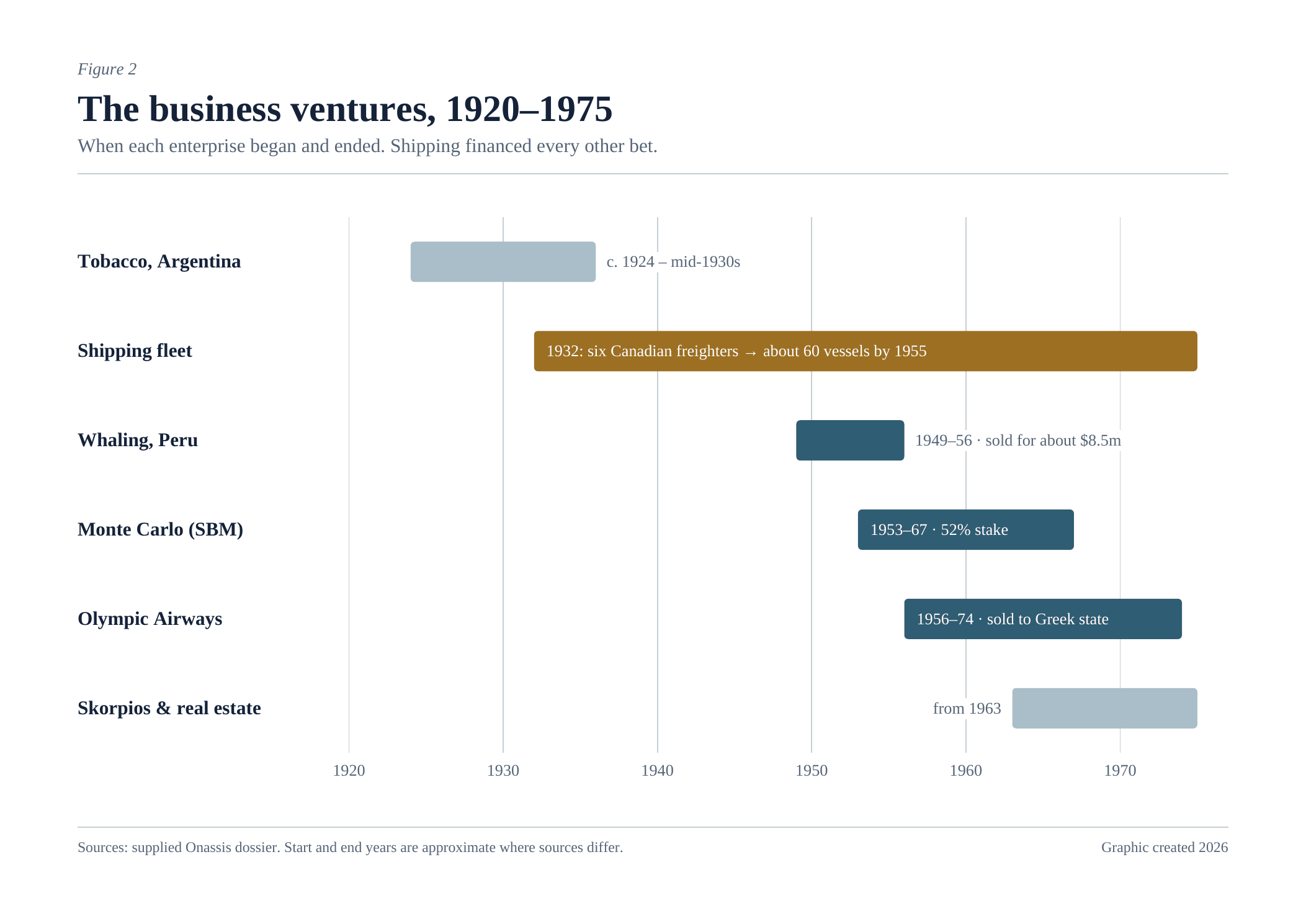
Using his father's contacts, he began importing Turkish leaf, betting that its mild character would appeal to a growing market of women smokers who found Cuban tobacco too harsh. When a deal with Juan Gaona's large local company fell through, he stopped selling raw leaf and started making and marketing his own cigarette brands.
The shift paid off. Within a few years he had earned his first million, and by the early 1930s he was a millionaire several times over. In 1929 he became an Argentine citizen and set up his first shipping-related company in Buenos Aires. Tobacco had given him capital; the sea would give him an empire.
Building the Shipping Empire
With profits from tobacco and stock-market speculation, he entered shipping in the depths of the Depression, buying six idle Canadian freighters at auction for roughly $20,000 each after hard bargaining. While established owners were laying ships up, he was buying cheaply and waiting for rates to recover.
The Second World War and its aftermath supplied the growth. He bought surplus vessels, including Liberty ships, and converted or chartered them out. The purchases later drew a United States Justice Department investigation into how Greek owners had acquired war-surplus tonnage, an accusation also levelled at Niarchos and Livanos.
By 1954–55 his empire spanned more than 30 companies owning around 60 vessels, mostly tankers and cargo ships. They were held through a web of flag-of-convenience entities in Panama, Liberia and Uruguay, such as Oceanic Transport and Olympic Steamship, and run from Monte Carlo as Olympic Maritime.
The real secret was the long-term charter. He signed fixed, favourable contracts with oil majors such as Texaco and Jean Paul Getty's Tidewater, then used those contracts to borrow against ships not yet built. The model tied his fortunes to oil and geopolitics, and the 1956 Suez crisis, which forced tankers around Africa, rewarded owners with big ships. His rivalry with brother-in-law Stavros Niarchos pushed both men to order ever-larger tankers; in the 1960s and early 1970s he contracted for about 20 very large crude carriers.
Whaling off Peru
Around 1949–50 he invested roughly $5 million in a whaling fleet. A T2 tanker became the floating factory Olympic Challenger, supported by 12 to 16 converted corvettes acting as catchers. Sailing under Panamanian and Uruguayan flags, with largely German and Norwegian crews, the fleet worked the Pacific off Peru and proved highly profitable.
It was also controversial, dogged by allegations of malpractice and poor conditions aboard, as well as a clash with Peru over its maritime limits. In 1956 he sold the entire operation to Japan's Kyokuyo Hogei for about $8.5 million, a healthy return on a venture that had grown too hot to hold.
Monte Carlo and the Prince
From 1953 he quietly bought shares in the Société des Bains de Mer, owner of the Monte Carlo Casino, the Hôtel de Paris and much of Monaco's best property. Using Panamanian front companies, he assembled a controlling stake of about 52 per cent.
Control brought conflict. Prince Rainier III wanted new tourist facilities to broaden Monaco's appeal; the shipowner preferred an exclusive enclave. In 1966 Rainier's government created 600,000 new shares for the state, cutting his stake to under a third. Monaco's Supreme Court upheld the move in 1967, and he walked away having lost the one contest where money was not enough.
Olympic Airways
In 1956 he bought TAE, Greece's small state airline, and relaunched it as Olympic Airways. He invested in modern jets, including Boeing 707s, and a glamorous brand built around the Olympic rings. For almost two decades Olympic was Greece's face in the sky. By the early 1970s, fuel costs, labour disputes and politics had turned it into a burden, and in 1974 he sold it back to the Greek state.
Oil, Property and a Private Island
Beyond ships and aircraft, he held stakes in property and hotels, including interests linked to the Skouras hotel group, and backed the Olympic Tower, a mixed-use skyscraper on Fifth Avenue in New York completed shortly after his death. He bought Skorpios, an island in the Ionian Sea, and turned it into his retreat. The yacht Christina O, a converted wartime frigate, became his floating office and the most famous private vessel of its day.
The Golden Greeks: how his Fortune Compared
He was the most visible member of a remarkable generation of Greek shipowners, but not the only giant. In 1969 TIME estimated that he and Niarchos had each built fortunes of about $500 million, yet named Costas Lemos, a low-profile owner from Oinousses, as the wealthiest Greek shipowner at roughly $750 million.
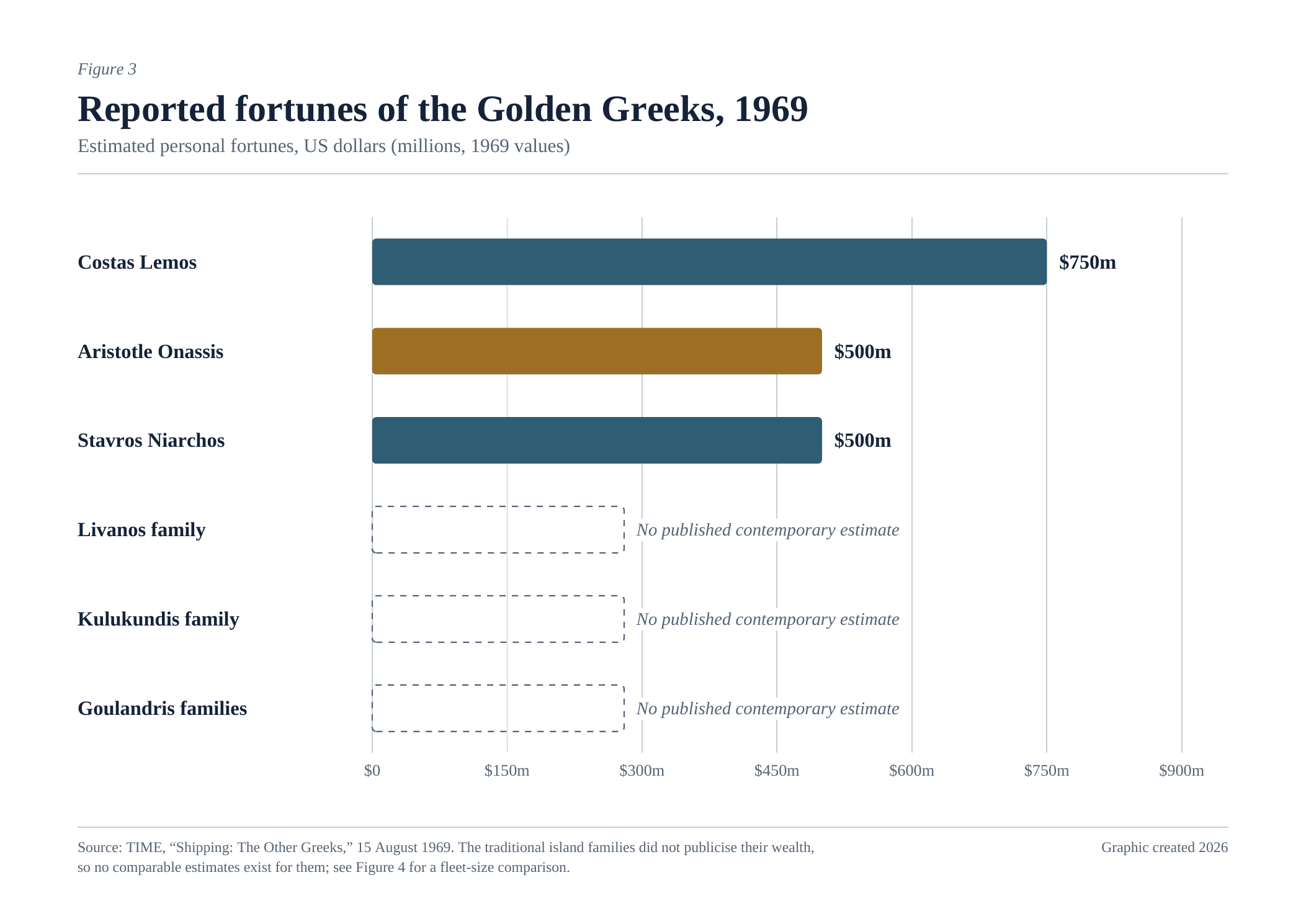
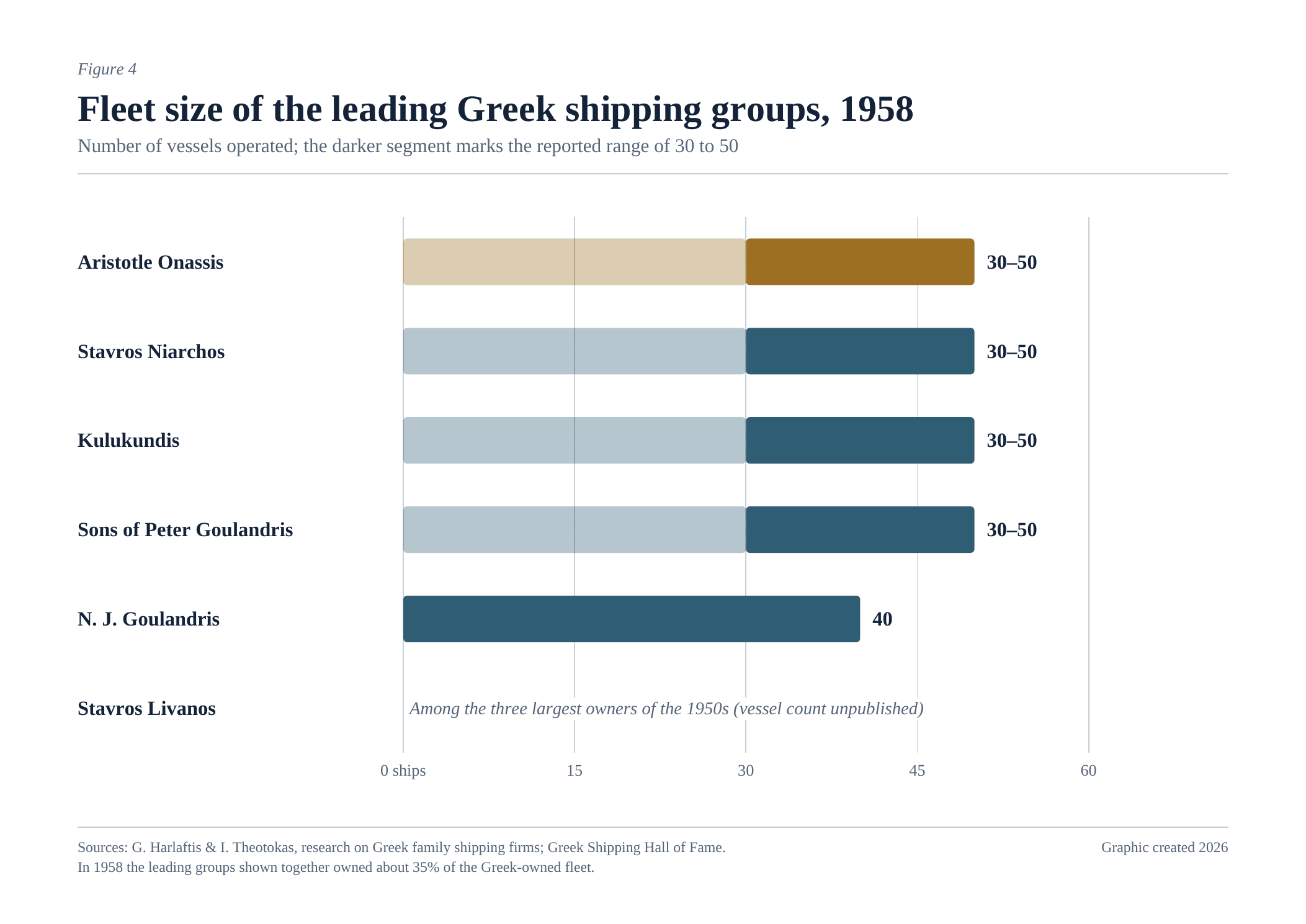
The families were bound together as much as they competed. Stavros Livanos, a cautious Chiot who financed ships with cash rather than debt and reportedly said he had no money, only ships, became father-in-law to both Golden Greeks. The Kulukundis clan of Kasos and the Goulandris families of Andros ran fleets on a similar scale but shunned publicity. The difference was style, not size: they built quietly, while he built in public.
Love, Marriage and Family
Tina Livanos
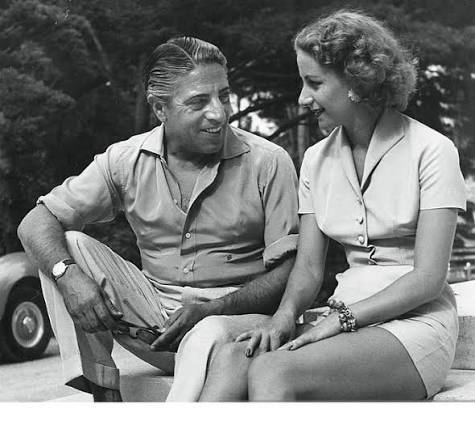
On 28 December 1946 he married Athina "Tina" Livanos, then seventeen. They had two children, Alexander in 1948 and Christina in 1950. The marriage ended in divorce in 1960, worn down by his affairs. In a twist worthy of opera, Tina later married Niarchos, her late sister's widower.
Maria Callas
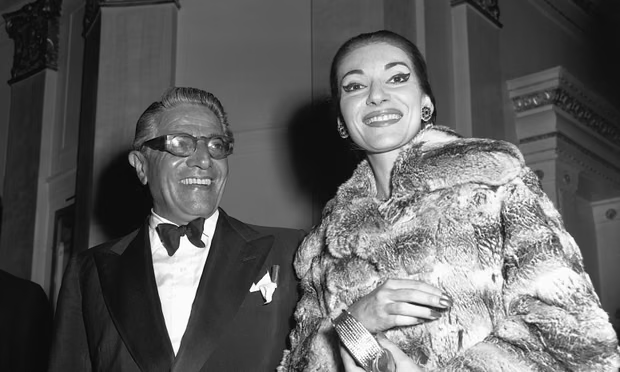
He met Maria Callas in 1957, and their affair became public in 1959 when she left her husband. For roughly nine years they were the most photographed couple in Europe, their relationship marked by passion and jealousy. He left her to marry Jacqueline Kennedy, yet according to people close to them they kept seeing each other, and by some accounts she visited him in hospital shortly before he died.
Jacqueline Kennedy
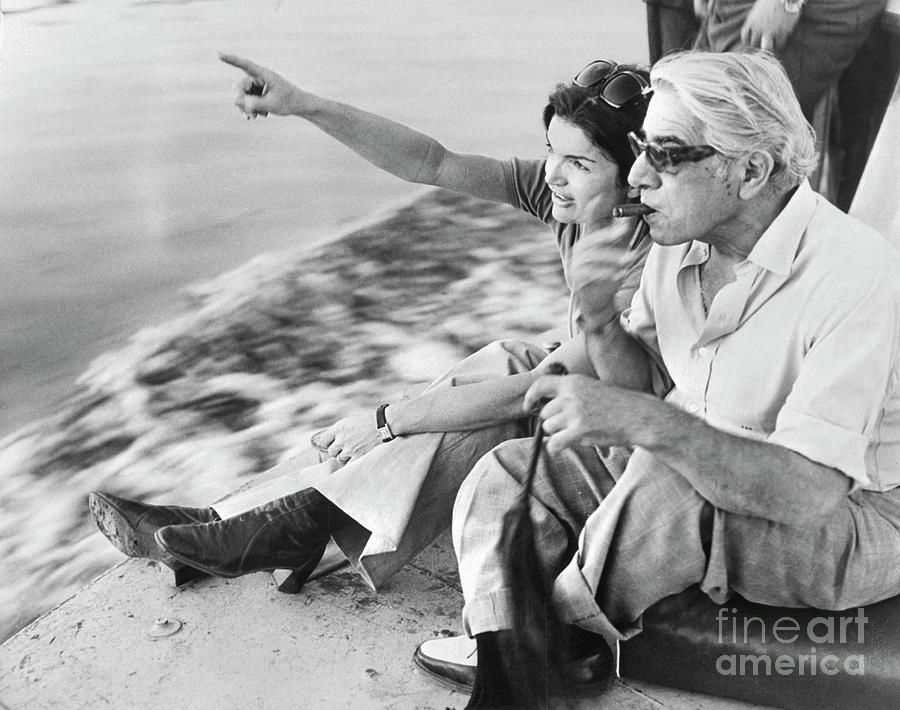
On 20 October 1968 he married the widow of President John F. Kennedy in a small Greek Orthodox ceremony on Skorpios. The match stunned the world. They moved between New York, Paris, Athens, Skorpios and the Christina O, but the marriage grew distant, though it lasted until his death.
The children
Alexander was groomed as heir and worked closely on the aviation business. On 23 January 1973, aged 24, he died after his Piaggio amphibian crashed on take-off at Athens' Hellinikon airport. Inquiries pointed to mechanical failure, but his father never fully accepted it was an accident. Christina inherited most of the fortune, ran the business for a time, married four times and had one daughter, Athina, in 1985. She died in 1988, aged 37.
Decline and Death
Biographers agree that Alexander's death broke him. He grew visibly weaker as myasthenia gravis, a neuromuscular disease, attacked the muscles of his face, eyes and chest; by 1974 his eyelids had to be taped open. In February 1975 he flew to Paris for treatment, accompanied by Jacqueline and Christina. His gallbladder was removed at the American Hospital in Neuilly, but bronchial pneumonia set in and resisted treatment, worsened by cortisone that weakened his defences. He died of respiratory failure on 15 March 1975, aged 69.
Legacy
His will left about 55 per cent of his fortune to Christina and about 45 per cent to create the Alexander S. Onassis Public Benefit Foundation in his son's memory. Legally based in Liechtenstein and run from Athens, it funds scholarships, research, the arts, health and social programmes, and has become one of the most influential private benefactors in modern Greek life. His granddaughter Athina, his only grandchild, is his principal heir.
His business legacy is just as durable. He helped normalise flags of convenience, pioneered financing ships against oil-company charters, and drove the race to supertankers that reshaped global shipping. The island, the yacht and the tower still carry his name, but his real monument is the model he left: a refugee who treated every crisis as a buying opportunity and every rival as a reason to build bigger.
Final Thoughts
Seen whole, his life follows a single arc: loss, reinvention, excess and, finally, grief. The boy who fled a burning Smyrna spent the rest of his days making sure he would never be powerless again. Tobacco gave him capital, tankers gave him scale, and oil-company contracts gave him leverage that few rivals grasped as early as he did. Monte Carlo and Olympic Airways showed the limits of that approach: money could buy control, but not always keep it, especially once governments pushed back.
His private life followed the same pattern. He pursued the most famous women of his age as boldly as he pursued charterers, yet he could not protect the son for whom he had built everything. After Alexander's death, the empire lost its purpose, and its founder lost the will to defend it.
What endures is less the fortune than the model. Greek shipowners still rank among the most powerful in world shipping, relying on the flags, financing structures and ship sizes he helped pioneer. Even his rivalry with Niarchos lives on in Athens, where both men's foundations support landmark cultural and medical institutions. His story remains a study in how far audacity can carry a person, and in what it can never buy.
Sources: