Every digital service runs in a physical building, and that building needs land, power, cooling and a lease. For property developers and landowners, data centres have become a distinct asset class, with unusually strong demand drivers: cloud adoption, artificial intelligence and data-residency requirements.
The sector is often described as a single industry, but it is closer to a spectrum. At one end sit hyperscale campuses drawing tens or hundreds of megawatts. In the middle are colocation and server-space providers that rent racks, cages and floors to businesses. At the other end are small specialist operators, such as services that rent dedicated Macs by the day, whose footprint may be a few racks inside someone else's facility. Each tier uses property differently, and this article looks at all three through a Greek lens.
Tier one: campus developers and hyperscale operators
At the top end, Greece's data centre pipeline is driven by international operators, infrastructure investors and a few domestic groups moving in from other sectors. These are campus projects measured in tens or hundreds of megawatts, built on multi-hectare sites with dedicated grid connections.
Data4 (Brookfield-backed, France). Its ATH01–HERMES campus in Paiania covers 7.48 hectares. In July 2026 it received environmental approval for three buildings and 80 MW of installed capacity, expanded from a licensed 15 MW first facility. The plan includes a 150 kV IPTO substation, and the site sits in an industrial zone about 20 minutes from central Athens.
Digital Realty (US). It acquired Greece's largest carrier-neutral provider, Lamda Hellix, in 2020 and has since expanded the Athens campus. A December 2024 report described Athens 3 as operating, Athens 4 and a Heraklion facility due in 2025, and Athens 5 dependent on demand.
Microsoft. It announced in October 2020 three data centres in the Spata area of Attica, and is also a major client of Digital Realty in Greece.
Apto and Dromeus Capital Group. A €300 million hyperscale project in Spata, in an industrial zone 15 minutes from Athens International Airport, reported to have pre-approval and high-voltage power secured. Apto is backed by Pimco. Dromeus is a property-focused manager that owned 26 commercial real estate assets around Athens at the time, which makes it a direct example of a real estate group entering the sector.
Gemini (IPTO and Serverfarm). A planned joint venture between Greece's transmission operator and a US data centre developer, starting with a 130 MW campus in the Greater Athens area on sites owned by IPTO. The partners have signed a heads of agreement.
Karatzis Group. A Crete-based industrial group, known for plastic netting and renewables, plans a €240 million campus near Orchomenos in Boeotia, about 100 km northwest of Athens. Seven buildings on 342,465 m² are designed for up to 430 MW at full build-out (reported March 2026).
PPC. The national power utility has announced a €2.3 billion, 300 MW first phase in Western Macedonia, scalable to 1,000 MW, with completion targeted for 2027. It also holds 45% of Data In Scale, a joint venture with the UAE's EDGNEX.
Several of these projects are announced rather than built, so timelines should be read as intentions.
Tier two: colocation and server-space providers
The middle of the market sells racks, cages and floors rather than whole campuses. These are usually single buildings in or near the city, often in industrial parks or converted commercial space, serving enterprises, banks, public bodies and cloud services that want local capacity and low latency.
Lancom. Described by the OCOLO colocation directory as the largest independent cloud provider in Greece, it owns three data centres across Athens and Thessaloniki, with a fourth planned in Heraklion, Crete. Its Athens facility is on Kifisias Avenue in Marousi. Lancom is Thessaloniki-based and has positioned its Balkan Gate facility there as a regional connectivity hub.
Synapsecom. Headquartered in an industrial park in Ano Liosia, it operates one data centre in Athens and one in Thessaloniki. The Athens site offers 2,500 m² of premises and 0.5 MW of power capacity, with a Tier 3 design, carrier-neutral colocation, cloud services and immersion cooling for high-density compute.
Lamda Hellix (now part of Digital Realty). Before its 2020 acquisition, its Athens campus housed two data centres hosting roughly two-thirds of Greece's data centre communities, with all national fibre providers and two Internet exchanges on site.
Sparkle. The international carrier arm of Telecom Italia is listed among the operators with data centres live or in development in Athens.
Two points matter for property. First, scale: Synapsecom's Athens site at 0.5 MW is roughly one-160th of Data4's planned 80 MW campus, yet both compete for the same scarce resources of power and fibre. Second, network gravity: the Lamda Hellix campus shows how tenants cluster where carriers and exchanges already meet, which makes established interconnection hubs hard to replicate.
Tier three: small operators and the dedicated-Mac model
At the smallest scale, specialist operators sell a narrow service from a handful of racks inside someone else's facility. Cloud Mac rental is a clear example. Apple's Xcode, which is needed to build and sign iOS apps, runs only on macOS, so a developer or studio can rent a dedicated Mac mini or Mac Studio remotely instead of buying and housing one.
Mac Depot sells exactly this. Its homepage describes dedicated, bare-metal Macs rather than virtual machines, accessed over SSH or remote desktop, with no contract. Its pricing page offers daily, weekly, monthly and 12-month plans in two regions, US Midwest and Greece (Athens), with a Mac mini M6 shown as coming soon in Athens. Listed prices on 5 November 2026 included $119 a month for a Mac mini M6 and $449 a month for a Mac Studio M5 Max, and several US models were marked sold out.
The real estate angle is indirect but instructive. Mac Depot does not say which facility hosts its Athens machines, but operators of this size generally rent rack space from a colocation provider rather than build anything, so their property footprint is effectively a line item on a colocation invoice. Capacity grows unit by unit: the company's emergency option buys a Mac mini and provisions it for remote access within 48 hours, against a three-month commitment.
Small operators are the most flexible tenants in the sector and the lightest in footprint, but they depend entirely on the tier-two landlords described above for power, cooling and connectivity.
What each tier needs from a property
Across all three tiers, the scarce inputs are electricity, fibre and permitted land, not the building itself. As RE+D Magazine put it in covering the Paiania campus, value is no longer set by land or buildings alone but by access to power, fibre and interconnection.
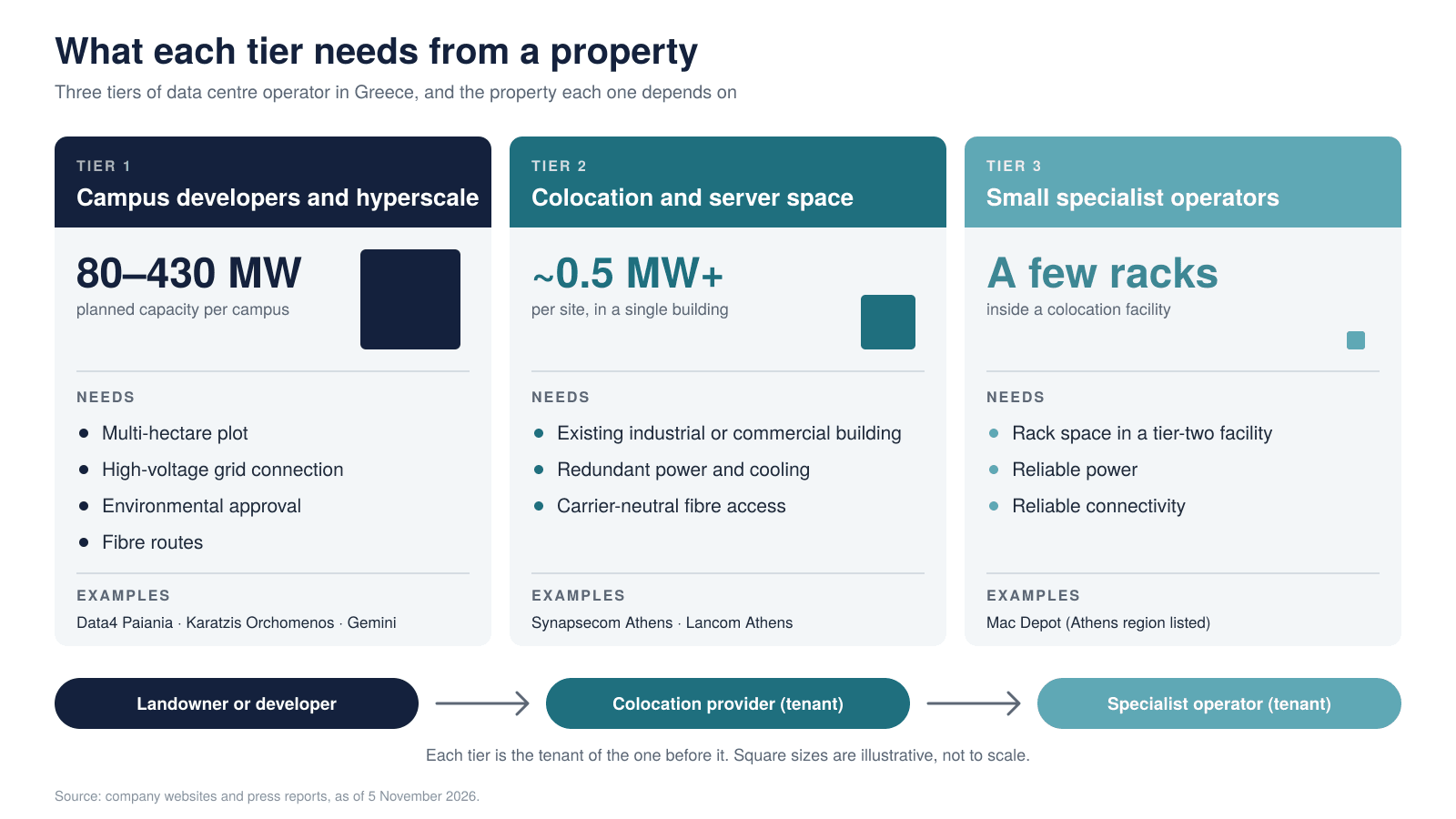 The tiers also sit in a chain. The campus developer is a landowner or long-term lessee, the colocation provider is its tenant or a smaller landlord in its own right, and the specialist operator is a tenant of the colocation provider. A development company can plausibly sit at any of these positions, as landowner, developer or occupier.
What this means for Athens and Greece
Greece is pitching itself as a data hub for Southeast Europe and the Eastern Mediterranean. Enterprise Greece cited 26 data centres in the country in March 2026 and about six subsea cables, and said investor interest was strong at Data Centre World London. Data4 expects the Greek market's capacity to more than double by the end of the decade, helped by new subsea cable systems linking Europe with the Middle East, Asia and Africa.
For developers, the most important recent change is regulatory. A draft energy bill submitted to Parliament on 31 October 2026 would transpose Directive (EU) 2024/1711 and set new conditions for connecting and operating data centres. As reported, it proposes:
an annual levy of €15,000 per MW of maximum consumption capacity, or €1.5 million for a 100 MW facility
at least 60% of annual electricity consumption covered by new renewable generation, which must be operating by the time the data centre is energised
the full cost of grid connection, including any reinforcement works needed only for the data centre, borne by the investor
a bank guarantee of €200,000 per MW, refunded once the full capacity is energised
priority handling for projects above 200 MW that commit new dispatchable generation or storage covering at least 80% of peak demand
The bill is still a draft, and terms may change before it becomes law. The direction is clear, though: proximity to suitable grid capacity and the ability to secure new renewable supply will weigh heavily on where projects are viable. For land, that favours sites near existing or plannable substations, such as the IPTO-owned sites in the Gemini plan and the industrial zones in Paiania and Spata, over plots that merely have space.
What landowners and developers should watch
Data centres range from an 80 MW to 430 MW campus down to a Mac mini in a rented rack, but every tier depends on the same property inputs: power, fibre and permitted land. Four things are worth tracking over the next twelve months:
The final energy law. The levy, renewable-supply and guarantee terms will shape project economics and site choice.
Which announced campuses start building. Data4, Apto, Gemini, Karatzis and PPC are at different stages, and only some have approvals or secured power.
Grid announcements. New substations and connection capacity from IPTO are likely to move land values more than zoning alone.
Colocation demand. Expansion by providers such as Lancom, Synapsecom and Digital Realty is an early signal of whether enterprise demand is absorbing space.
Figures in this article come from company websites and the press reports cited below, as of 5 November 2026. Announced projects may change.
Sources
Data4 breaks ground on its mega data centre campus in Paiania, RE+D Magazine, 2 July 2026
Greece introduces new energy requirements for data centre investments, RE+D Magazine, 2 November 2026
Greece develops as data center hub for Southeast Europe, Eastern Mediterranean, Enterprise Greece, March 2026
Investments in data centers in Greece, Naftemporiki, 16 December 2024
Interxion establishes presence in Greece with acquisition of Lamda Hellix, Intelligent CIO Europe, 13 November 2020
Apto partners with Dromeus Capital for Greek data center in Athens, DatacenterDynamics
Gemini targets hyperscale development in Greece, Digitalisation World
Karatzis Group announces €240 million, 430MW data center campus in Central Greece, IDCnova (citing DatacenterDynamics), 6 March 2026
Synapsecom Athens Data Center, Synapsecom
Lancom: Athens Data Center, OCOLO
Mac Depot homepage and pricing page, Mac Depot, viewed 5 November 2026