We are heading for a new record in foreign direct investment in 2022 (tables)
Despite its major challenges, 2022 shall be recorded as the year in which major foreign investments took place in the country. Already the latest figures from the Bank of Greece, as revealed by its deputy governor Theodoros Pelagidis, show that they have exceeded 3.5 billion euros, when last year's was 4.84 billion euros, setting a 20-year record. And with the momentum with which investment activity in the country appears to be developing and the new projects announced, it seems that the country has entered an unprecedented period of investment demand.
In fact, if we add to the direct foreign investments those of the Public Investment Programme, the old NSRF, which are in progress, as well as the new one, and those of the Recovery Fund, which are beginning to gain momentum, one could talk of an investment frenzy.
"The government's coherent strategy on attracting foreign direct investments, the reduction of administrative burdens by reducing bureaucracy, the digitalization of the state and, above all, the great credibility of the government and the Ministry of Development and Investments to all those who have come to invest in Greece in the last three years have created an extremely favorable investment climate for our country and have led to an absolute investment record since the very first day we recorded this indicator," the minister responsible for investment in Greece, Adonis Georgiades reports to "business stories". "I am proud that during my tenure we achieved our big goal of surpassing every previous year in terms of investment," he adds.
The extremely favourable investment climate created by the government has brought the absolute investment record.
The record-breaking investment activity at the moment, of course, also acts as a buffer against the back wash brought to our country by international inflationary pressures, the energy crisis and rising interest rates from major central banks that are putting a damper on economic activity. Were it not for these, the government believes that the investment wave might have been even bigger, on the other hand, however, the international situation has also helped to promote investment projects in our country. A typical example is Deutsche Telekom's recent investment in Thessaloniki where it has set up its new IT hub, which is essentially a transfer of what they had in Russia. In fact, for its operation, more than 250 employees have been transferred from abroad - mainly from Russia - while more than 200 IT professionals will be recruited in Greece for its complete staffing.
Countries of origin of Foreign Investments | Number of Projects | Share 2021 | Share 2020-2020 |
USA | 7 | 23% | 26% |
United Kingdom | 5 | 17% | 12% |
Denmark | 4 | 13% | 3% |
Austria | 2 | 7% | 0% |
German | 2 | 7% | 12% |
India | 2 | 7% | 0% |
Italy | 2 | 7% | 5% |
Spain | 2 | 7% | 2% |
Cyprus | 1 | 3% | 2% |
Israel | 1 | 3% | 0% |
Romania | 1 | 3% | 11% |
Turkey | 1 | 3% | 11% |
Holland |
|
| 5% |
French |
|
| 4% |
Switzerland |
|
| 4% |
China |
|
| 4% |
Japan |
|
| 3% |
Norway |
|
| 2% |
Ireland |
|
| 2% |
Sweden |
|
| 2% |
UAE |
|
| 2% |
Canada |
|
| 1% |
Australia |
|
| 1% |
Other Counties |
|
| 7% |
*Source EY Attractiveness Survey Greece 2022
Geographical distribution of investments. Four investment projects were attracted by Macedonia, two each by Central Greece and the Peloponnese and one by Epirus.
Strategic investments
One thing is certain: the pipeline of applications for inclusion in the strategic investment continues to grow. According to information, there are currently projects in the pipeline for inclusion with a total value of more than €7 billion. The interesting thing is that these investments concern a wide range of sectors. "The investments are mainly in logistic centers, renewable energy, tourism, agricultural production with added technological value and of course in the development of marinas and ports," says the Minister for development who also chairs the Inter-Ministerial Committee for Strategic Investments. Among the new applications, according to "b.s." information, is that of the world's largest independent data center management company, Equinix, which is interested in acquiring infrastructure in our country. It should be noted that this sector appears to be particularly interesting, as there is a great demand in the context of the country's digital transition. In this context, not only are the major investments already announced (Microsoft has proceeded with the licensing for the construction of its three complexes, Lamda Hellix is initiating the procedures for the new data centre in East Attica, Lancome is promoting the project in Crete and so on), but new ones are also being planned. For example, the agreement between PPC - Saudi Telecom - TTSA - Cyta to form a consortium to lay a data cable linking Asia to Europe via Saudi Arabia and Greece, which was recently signed during the official visit of the heir to the throne of Saudi Arabia to Greece, provides, among other things, for a number of individual projects such as the construction of two data centres in Attica and Crete.
The Arabs
However, the agreements concluded between Greek and Saudi businesses during their recent mission to our country create the basis for significant future moves in key sectors. Among the agreements is the one between Mytilineos Group and Ajlan & Bros Holding Group (Abilitii) where co-investments will be sought in the sectors of conventional energy, renewable energy, natural gas, but also in other newer technologies such as hydrogen. At the same time, and the country's successful rapprochement with the United Arab Emirates has led to the recent commitment by Abu Dhabi's Public Fund ADQ to invest up to €4 billion. These investments will not only involve large projects, but even stakes in Greek venture capitals and private equity funds. Already last month a delegation from ADQ had a series of meetings with Greek fund managers and heads of large and small groups in order to examine specific cases.
Major projects
The biggest investment projects, worth several billion euros, that will be launched in the country are admittedly those relating to energy, due to the effort for energy security and the transition to clean forms of energy. In this context, in terms of investment, a number of projects are already underway. The main ones that will be carried out immediately are the large floating LNG gasification plant in Alexandroupolis by the Kopelouzos Group, the corresponding one in Corinth by Motor Oil, the investments in Amfilochia and Amari Crete by GEK TERNA, as part of the pumped storage planning, the large RES projects of PPC in cooperation with RWE in Western Macedonia, but also the other RES projects launched by the Mytilineos Group and Hellenic Petroleum respectively. It should be noted that several new natural gas plants are also in the planning stage, but these are currently on hold due to the energy crisis triggered by the Russia-Ukraine war. The only definite one, which will start operation next autumn, is the one of the Mytilineos Group in Aspra Spitia Boeotia. Important moves are also expected in tourism, which is on course for new records. First of all, the Inter-Ministerial Committee for Strategic Investments recently approved the major 840 million euro project of Vita Development in Saronida, where an entire city will be built on the large area of the building cooperative "Health". This is the creation of a complex tourist accommodation, with a golf course, a heliport, a tourist village, a tourist port, renewable energy production facilities, a solid waste management unit, desalination and biological purification of waste water, modern housing, as well as school infrastructure and a health centre.
And although it is not yet clear when this project will start, investments in the hospitality sector continue unabated, both in terms of extensions and new projects. As far as extensions are concerned, the case of Costa Navarino is typical, as it has a wide-ranging investment programme of 250 million euros underway in the Peloponnese. The brand new "W" just arrived one of the Marriott Group's leading brands and in 2023 the debut of Mandarin will follow Also, the Sani/Ikos group is continuously expanding the Ikos brand in - but also outside - Greece (€500 million) with new resorts in top destinations such as Corfu and Crete, and an investment programme of €520 million. Furthermore, looking ahed to 2023, Grivalia Group is preparing the new "Asteria " Glyfada". In fact, according to reports, the group is expected to announce soon a new mega project that will exceed 250 million euros.
But there is also a lot of activity in the industry. While most of the investments may involve expansions to existing infrastructure, there is no shortage of new manufacturing units. Perhaps most typical is the case of pharmaceutical companies which, taking advantage of the so-called "investment clawback", the arrangement whereby funds that would have been returned to the state are used for new investments, have launched a major investment programme of more than €600 million for the creation of new plants and Research and Innovation Centres. In any case, the environment in Greece continues to be pro-investment despite the difficulties caused by new international challenges. And this is helped by a number of factors working in its favour. First and foremost, the positive momentum and records of 2021 have now been carried over into 2022. From then on, there is the Recovery Fund and the new NSRF, which are already underway and will secure a total of €70 billion in support for new investment projects. At the same time, there is still the remainder of the old NSRF, through smaller actions. To these must be added the simplification of bureaucratic procedures through continuous interventions that have been made either for the extension of the strategic investment regime, or for the new development law and so on, the various targeted regulations, such as the one for the restart of shipyards, and the incentives for company mergers.
It is no coincidence that since last year the mergers and acquisitions sector has also been significantly revitalised! This year alone there have been 14 notable deals in food, beverages and retail with the participation of major companies such as Chipita (completion of the acquisition by Mondelez International) and ION (acquisition of 45% by Mr Spyros Theodoropoulos), while the deal for the sale of Three Cents by the Ideal group to Coca-Cola HBC was also announced.
Greece is resilient
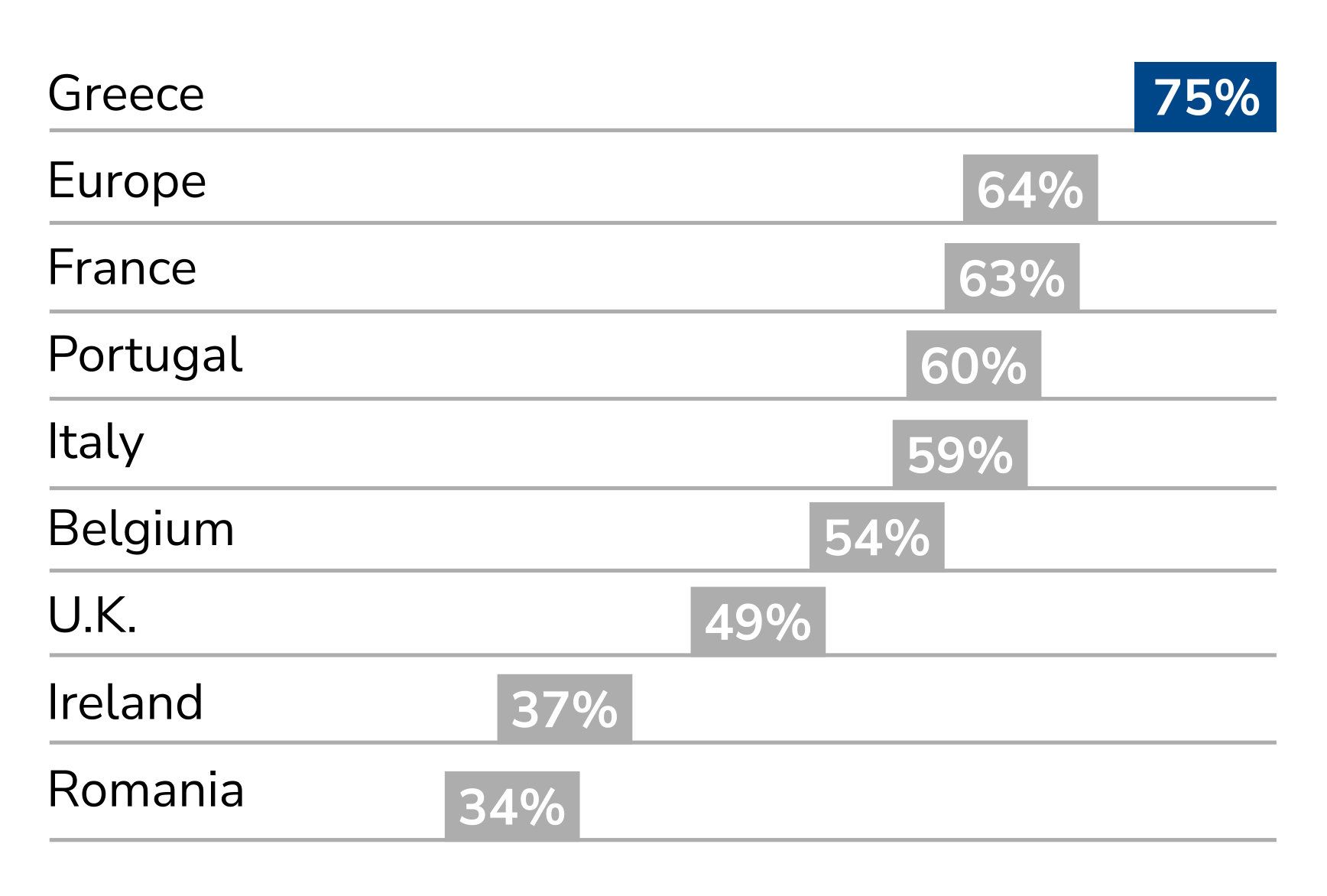
In any case, the country's investment gap is gradually narrowing. This is why, in its annual report recently published by EY on Greece's attractiveness as an investment destination (EY Attractiveness Survey: Greece 2022), our country appears resilient despite the increased uncertainty across the European continent. According to it, 37% of businesses plan to invest or expand their operations in Greece over the next year, while three out of four investors (75%) believe that Greece's attractiveness will improve further over the next three years. Indeed, although the war in Ukraine has inevitably created a negative psychology in the global investment community, the survey for Greece reflects smoother circumstances. Significantly, one in three companies (32%) say they have delayed their immediate investment plans for Greece until 2023, or later, as a result of the war. However, more than half of respondents (54%) say that no changes in their planning have occurred, while 13% of respondents say they are making a small (<20%) increase in planned investments.
*Comparison to other countries. The believe that the country’s image shall improve within the next three year. Attractiveness Survey 2022
 High value-added investments
According to the EY European Investment Monitor, an extensive database processed by EY with the exclusion of tourism, 30 foreign direct investments were made in Greece in 2021, the second best performance for the country since the survey began in 2000, after last year's record number of 39 investments.
But two things are noteworthy: first, cumulatively, the investments of the last two years represent 24% of the total investments made in the last 22 years and, second, the shift towards high value-added investments intensified in 2021.
FLOWS OF DIRECT FOREIGN INVESTMENTS IN GREECE IN THE PERIOD 2010-2021 IN MILLION EUROS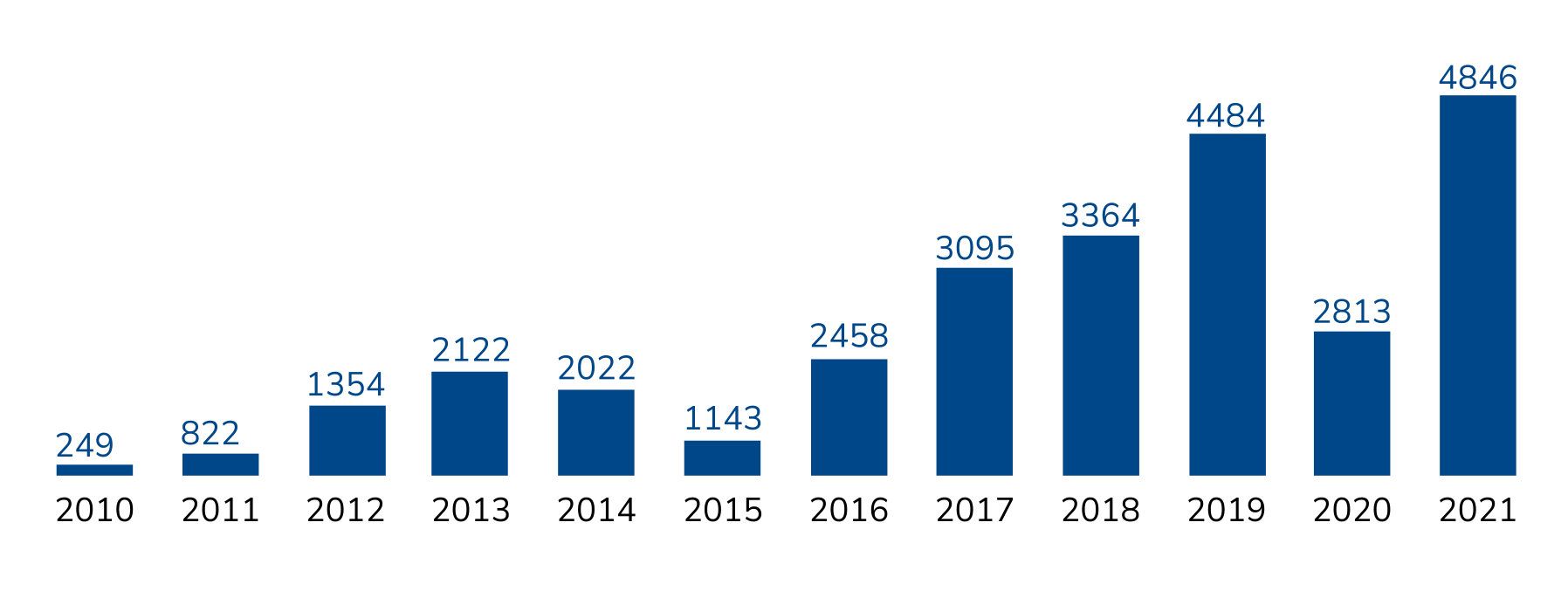 In terms of the type of activity to which the investments are directed, 30% are investments in headquarters, compared to only 4% between 2000-2020 and 7% in Europe as a whole in 2021, with industrial activities (20%) and logistics activities (17%) in second and third place respectively.
In terms of economic sectors, agri-food (20%), transport and logistics (20%) and software and information services (17%) are the highest ranked, three sectors linked to important comparative advantages of the Greek economy: the quality of its agricultural products, its geographical location and the skills of its human resources.
WHAT TYPE OF INVESTMENT WOULD YOU PREFER?
*Sample of 92 respondents planning to invest in Greece in the following year 2021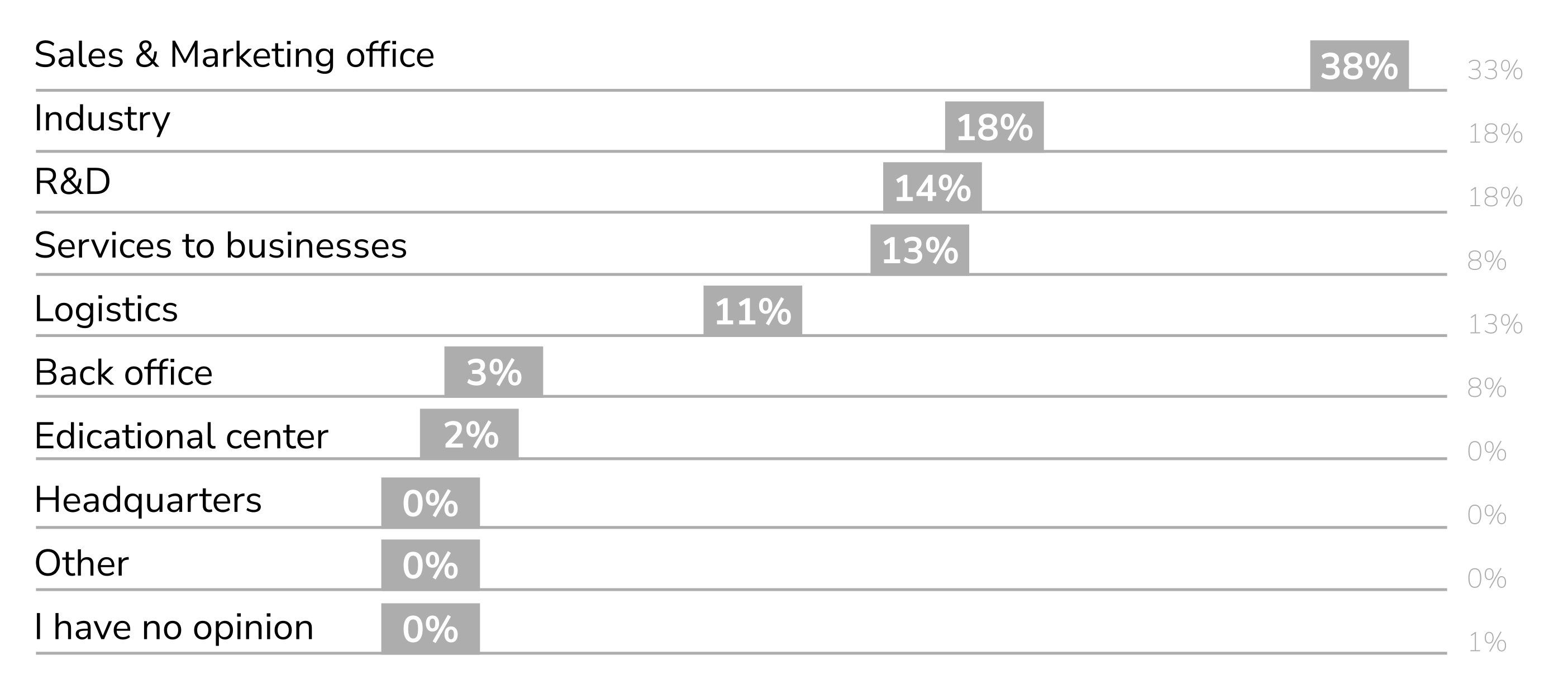
INVESTMENTS PER SECTOR
| Greece 2021 | Europe 2021 | Greece 2000-2020 |
Agri –food sector | 20% | 6% | 11% |
Transports and logistics | 20% | 4% | 8% |
Logistics & computer services | 17% | 19% | 9% |
Professional Services & Business Services | 7% | 12% | 3% |
Mechanical equipment | 7% | 8% | 3% |
Supply and provision of utilities | 7% | 3% | 3% |
Petroleum & Natural Gas | 7% | 1% | 4% |
Transport Equipment | 3% | 5% | 3% |
Financial Sector | 3% | 5% | 8% |
Consumer products | 3% | 3% | - |
Electronics | 3% | 5% | - |
Telecommunications | 3% | 4% | 1% |
Chemicals, plastics & elastics | - | 5% | 9% |
The views of the investment community on the policies pursued to improve individual aspects of the country's attractiveness are recorded as being of considerable value. This finding seems to confirm that investors attribute the improvement in the country's image to the implementation of specific policies rather than to the timing and the end of the period of uncertainty caused by the economic crisis. In particular, policies to attract businesses (81%), to attract human resources (78%), to attract innovative activities (75%), to attract capital (65%), to attract headquarters and decision-making centres (58%) and to create competitiveness centres and global hubs (55%) are positively assessed.
Strengths and weaknesses
Quality of life (75%), transport and logistics infrastructure (73%), telecoms/digital infrastructure (72%), the internal market (72%), and human resources skills (70%) emerge again as strengths of the country's attractiveness. On the other hand, the flexibility of labour laws (46%), the country's geopolitical position (47%), the education system (48%) and access to finance and availability of capital in Greece (48%) emerge as less attractive elements.