Buying real estate in Greece involves obtaining a tax number (AFM), hiring a local lawyer, securing financing, and completing the property transfer through a notary - a process that typically takes 2-4 months from start to finish. With property prices still recovering from previous lows and the government actively encouraging foreign investment through favorable visa programs, 2025 presents an ideal window for international buyers. The combination of stunning locations, growing tourism infrastructure, and accessible financing options makes the countries real estate an attractive proposition for both lifestyle and investment purposes.
Key Takeaways
Non-EU buyers may require documentation for certain regions, but overall the process is foreigner-friendly.
Partnering with local professionals is essential for smooth transactions.
Be aware of tax obligations and other fees to avoid surprises.
Thorough research and due diligence will help you avoid hidden costs and disputes.
Why Invest in Greek Homes?
Investing in Greek homes offers exceptional value with property prices still 30-40% below pre-2008 peaks while delivering consistent 7.29% annual returns and strong rental yields from Europe's fastest-growing tourism market.
The country has become increasingly popular for international buyers due to several factors:
Affordable Opportunities:ome prices are significantly lower than in other Mediterranean countries. In 2024, The average price for residential properties in northern suburbs was approximately €3,315 per square meter, with a range from €1,659/m² to €5,479/m² depending on the specific area, compared to €4,168 per square meter in Barcelona, Spain, or €11,081 in Paris, France.
Between 2014 and 2021, a total of 9,610 main applicants received their Golden Visa in Hellenic Republic. As of 2023, over 31,000 Greek Golden Visa permits were granted to the main applicants and their dependents in total. These applications directed in excess of €2.6 billion of global funds into the country.
Natural Beauty and History: The country’s islands, coastline, and cultural heritage attract millions of tourists yearly, boosting rental opportunities. In 2024 alone, welcoming over 36.9 million international visitors.
Are Property Prices Dropping?
Property prices in the Hellenic Republic are not falling in 2024-2025, continuing their upward trajectory for the 27th consecutive quarter despite significant growth moderation. Urban house prices rose 7.29% year-over-year in Q3 2024, down from double-digit increases of 13.28% in 2023, signalling a transition from rapid recovery to sustainable appreciation. The property market is experiencing what experts call a "soft landing" – cooling from overheated growth while preserving underlying strength driven by tourism recovery, foreign investment, and structural supply constraints. Transaction volumes surged 28.7% in 2024, supported by €1.14 billion in foreign direct investment during the first half alone.
Can Foreigners Purchase property in Greece?
Yes, foreigners are allowed to buy. EU citizens face no restrictions, while non-EU nationals may need special permissions for properties near border areas. This requirement is straightforward to manage with the help of legal professionals.
Steps for International Buyers:
Obtain a Tax ID (AFM): Essential for all financial transactions.
Open a Local Bank Account: Necessary for payments and tax filings.
Hire Local Experts: A lawyer and notary will ensure compliance with local regulations and manage legal documentation.
Is It Easy to Buy a Home?
Yes, with the right preparation and professional assistance, the process is straightforward. That said, some administrative hurdles, such as paperwork and bureaucracy, may cause delays.
Step-by-Step Overview:
Search for Suitable Options: Use licensed agencies or platforms.
Sign a Preliminary Agreement: Secure your choice with a deposit, typically 10% of the investment price.
Perform Due Diligence: Have legal experts check for debts, ownership disputes, and regulatory compliance.
Finalize the Contract: Complete the transaction through a notary.
Pay Required Taxes: Ensure all legal obligations are settled before the title transfer.
What Challenges Should You Be Aware Of?
Property buyers should prepare for challenges including limited financing options for non-residents, seasonal market fluctuations in tourist areas, and potential property management difficulties for absentee owners.
Foreseeing potential risks:
Unclear Titles: Approximately 15%-20% of properties in the country as a whole lack proper registration due to historical issues.
Boundary Issues: Rural or island properties may have unclear or disputed boundaries. Surveys conducted by topographical engineers can help resolve these disputes.
Renovation Costs: The average renovation cost for older homes ranges from €700 to €1,200 per square meter, depending on the scope of work.
Complex Bureaucracy: Local processes can be slow. For example, title registration through the Cadastre system can take several months.
How Much Tax Will You Pay?
When purchasing a home, several costs apply:
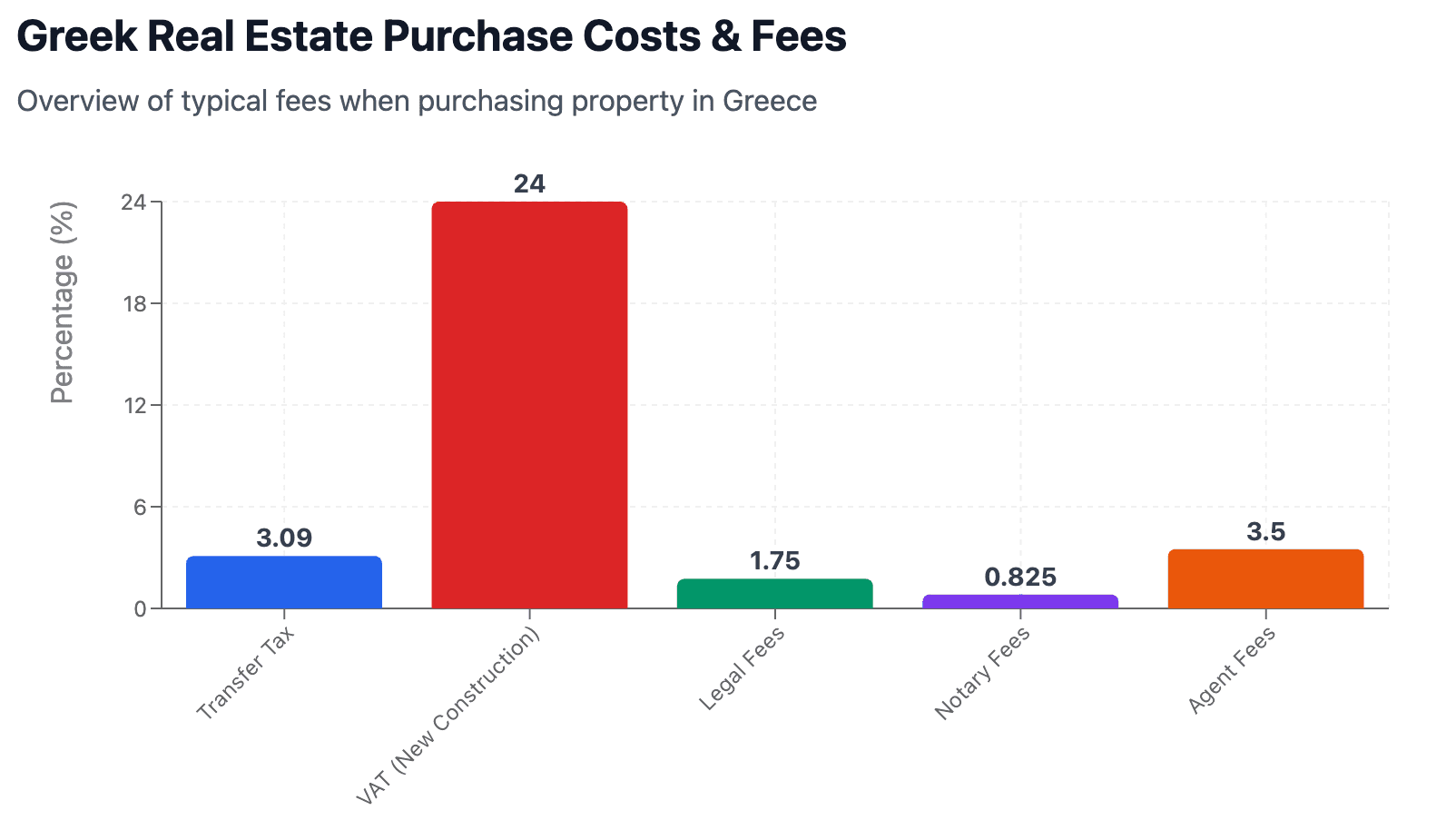
Transfer Tax: Typically 3.09% of the declared value. For properties worth €300,000, this amounts to €9,270.
VAT: Applicable at 24% for new constructions, which are those with building permits issued after 2006.
Legal Fees: Around 1.5%-2% of the purchase price. For assets worth €250,000, this translates to €2,500–€5,000.
Notary Fees: Approximately 0.65%-1% of the residence value.
Agent Fees: Usually 2%-5% of the transaction value.
Buyers should also consider ongoing expenses like property taxes (ENFIA), which can range from €2 to €16 per square meter annually, depending on the location and asset value.
 (source: wise)
Important Notes:
VAT (24%) applies only to new constructions with building permits issued after 2006
Transfer tax applies to older properties and resales
Legal and notary fees are typically paid at closing
Agent fees are usually negotiable and may vary by region
Final Thoughts
Owning property in this Mediterranean country is a gateway to enjoying its breathtaking landscapes, warm climate, and rich culture. The market is growing steadily - in the first half of 2024, property transfers surged by approximately 20% compared to the same period in 2023, reflecting ongoing demand and favorable market conditions. This growth makes it a promising option for both lifestyle seekers and investors. However, purchasing a home requires attention to detail and expert guidance to navigate potential challenges successfully.
By understanding the process and securing reliable local support, you can confidently navigate the market and make a smart, informed decision. Whether you're dreaming of a seaside villa or a charming urban apartment, this guide equips you with the knowledge to take the next step toward owning your perfect Mediterranean home.
Frequently Asked Questions
How hard is it for an American to buy a house in Greece?
Americans can buy Greek property without restrictions, but should expect a 2-4 month process involving tax registration, legal documentation, and professional fees adding 8-12% to the purchase price.
Finding an estate agent in Greece
To find an estate agent, start by researching online for reputable agencies, checking reviews, and seeking recommendations from expat communities or local forums. It's advisable to choose agents who are familiar with the area you're interested in and have experience working with international buyers.
What is the Golden Visa?
The Golden Visa program provides a residence permit in the country to investors from non-EU countries. The minimum investment amount is €250,000, however from 2024, in several popular regions, the threshold has been increased to €400,000 and €800,000. The residence permit gives the right to free movement within the Schengen area countries and can be the first step towards obtaining citizenship.