
Residency by investment remains one of Europe's most compelling offers, and this particular program continues to draw strong interest from non-EU nationals. It combines a Mediterranean lifestyle, Schengen-area travel rights, and a tangible euro-denominated asset in the form of property. Rule changes over the past two years have reshaped the landscape, so understanding today's thresholds, procedure, and long-term implications is essential before committing.
What the Program Offers
Launched in 2013, the scheme grants a five-year renewable residence permit to qualifying non-EU, non-EEA, and non-Swiss nationals who make a qualifying investment, most commonly in real estate. Unlike many comparable schemes, there is no minimum physical stay requirement, applicants are not obliged to live locally to maintain or renew their permit. For families seeking a European base, future schooling options, or simply a contingency plan, that flexibility is a major draw.
Property remains the most popular route because it pairs residency eligibility with an asset buyers can see, inspect, and understand. Unlike some other investment categories, real estate lets an investor know precisely what they own, where it sits, and how it may perform over time with the added potential of rental income and long-term appreciation.
Beyond the residency rights themselves, the appeal rests on a relatively stable property market, a lower cost of living than many parts of Western Europe, and a transparent legal framework for foreign ownership. The capital region stands out for year-round liquidity and stronger rental fundamentals compared with seasonal coastal or island markets.
Investment Thresholds in 2026
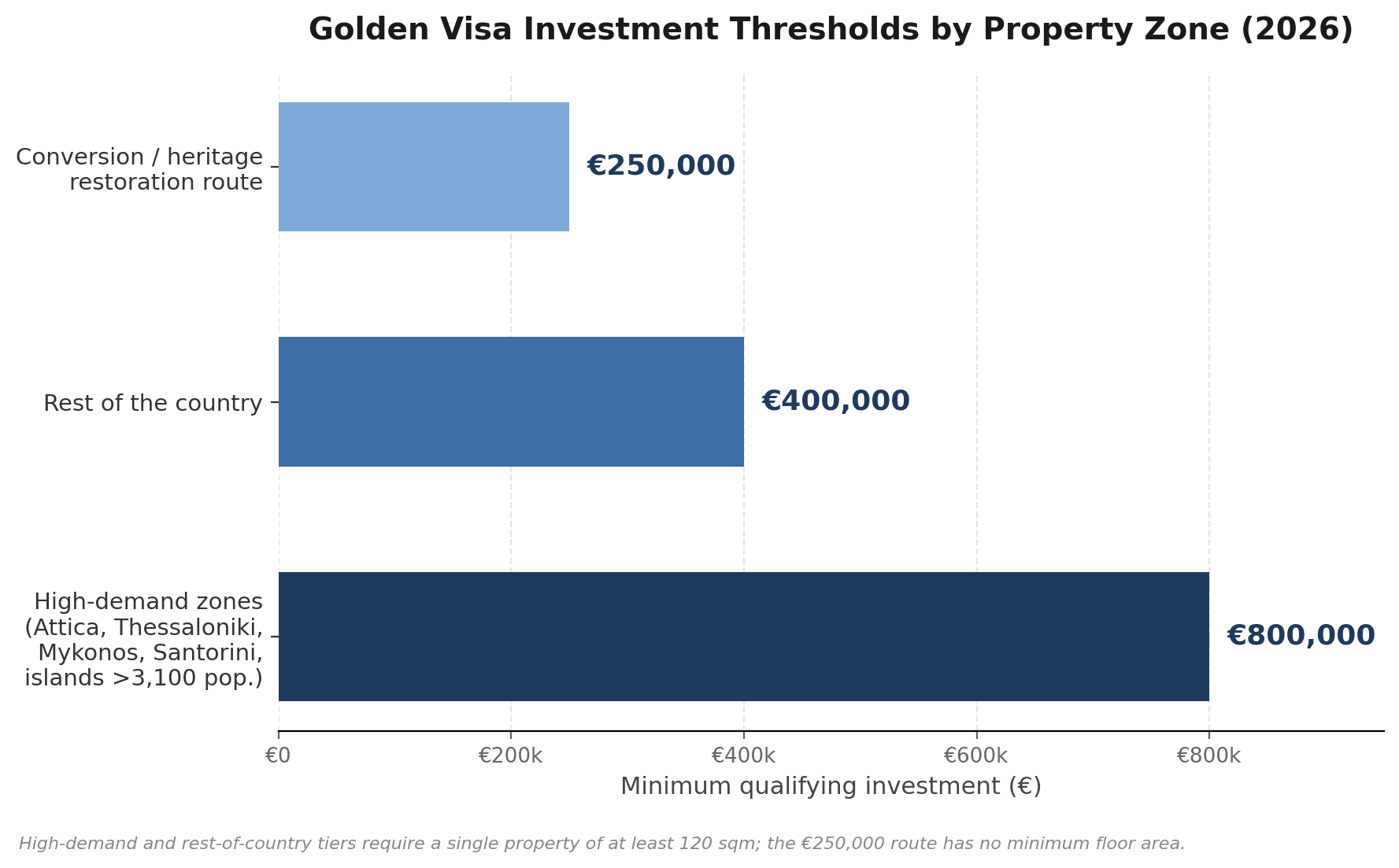
Since September 2024, a tiered structure applies, and all transitional windows have now closed. Every new application must meet one of the following:
€800,000 — high-demand zones. This covers the wider Attica region (central, northern, and southern districts), the Municipality of Thessaloniki, Mykonos and Santorini, and any island with a population above 3,100. The purchase must be a single property of at least 120 square metres.
€400,000 — the rest of the country. The same single-property, 120-sqm minimum applies; multiple smaller units cannot be combined to reach the threshold.
€250,000 — conversion and heritage pathways. Two exceptions remain at the original entry level regardless of location: converting a commercial building (office, retail, or industrial) into residential use, or purchasing and fully restoring a listed heritage building. Neither has a minimum floor-area requirement, but converted units cannot be used for short-term rental platforms, and the change of use must be legally finalised before applying.
 Because eligibility depends on title status, zoning, and building documentation as much as price, a property that looks attractive on paper can still fail to qualify. Independent due diligence is essential at every tier.
Step-by-Step Process
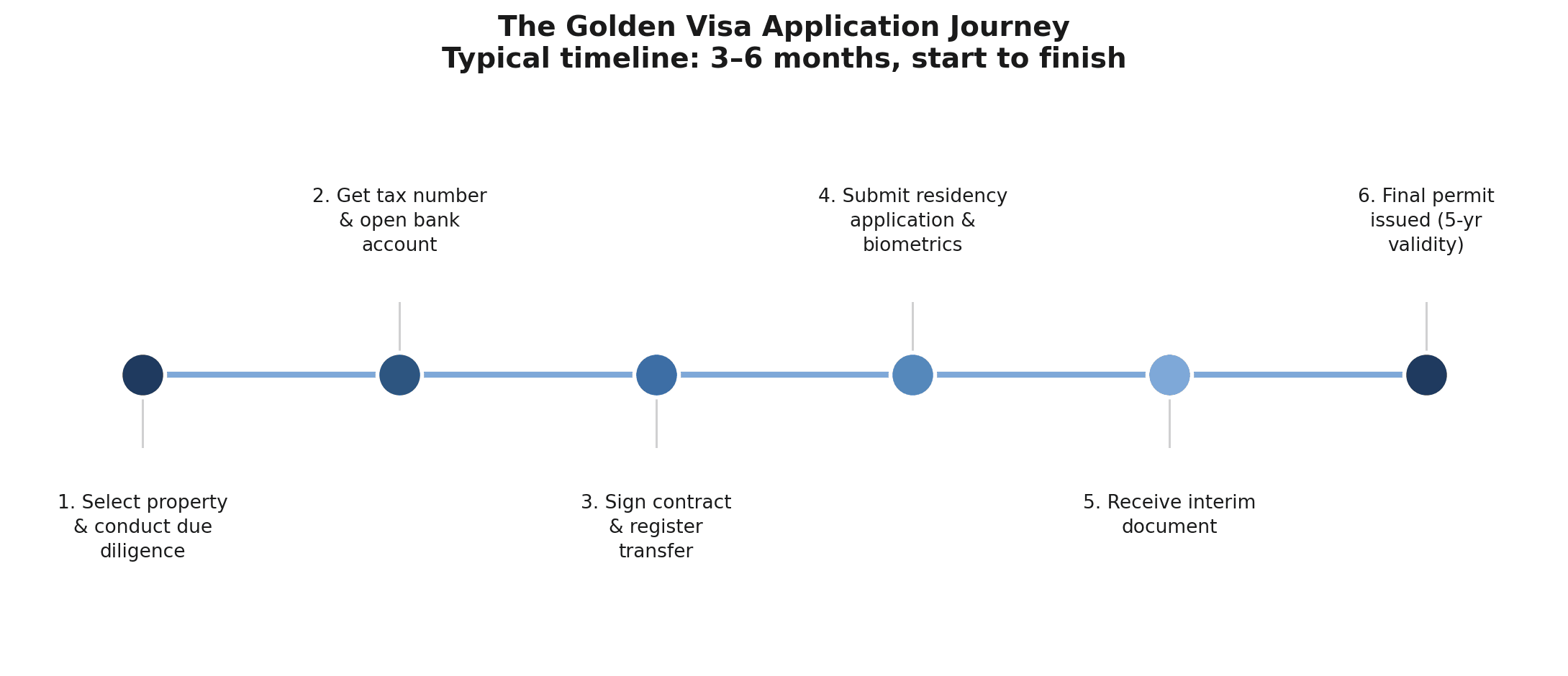
1. Define a strategy and select the property. Work with a lawyer who is independent of the seller or developer and experienced in cross-border transactions. They should confirm ownership, check for encumbrances or planning violations, and verify the asset meets the program's size and zoning rules.
2. Obtain a local tax number and bank account. The main applicant and any family members included on the application need a tax identification number, and a local account is required to transfer funds and manage future obligations.
3. Sign the purchase contract and complete the transfer. Once due diligence is finished, the notarised agreement is signed. Funds must move through the banking system and be clearly traceable to the buyer before the transfer is registered with the land registry.
4. Prepare the residency application. With the property registered, the lawyer submits the permit application, typically requiring a valid passport, proof of medical insurance, the purchase contract and land registry certificate, evidence of the bank transfer, a clean criminal record certificate, and biometric data collected at a designated immigration office.
5. Receive interim approval, then the final permit. After biometrics, applicants usually receive an interim document allowing them to reside and travel while the application is processed. Final issuance can take several months depending on office workload; the resulting card is valid for five years.
6. Include family members. A single qualifying investment can cover the main applicant, their spouse, children up to 21, and both sets of parents, with no additional investment required, provided dependency or family-reunification criteria are properly documented. Each person receives an independent permit.
Key Benefits
Schengen mobility: visa-free travel across the Schengen Area for up to 90 days in any 180-day period.
No residency obligation: the permit stays active as long as the investment is maintained, there's no requirement to spend a single night on-site, though many owners eventually choose to.
Rental income and asset ownership: a tangible property that can generally be let long-term (conversion-route properties are the exception, as they're barred from short-term letting).
Indefinite renewal: the permit renews every five years as long as the investment is retained.
A path to citizenship: after seven years of actual, physical residence. not simply ownership, naturalisation becomes possible, subject to language and integration requirements. Time spent holding the permit counts toward this timeline, but genuine presence is required.
Costs, Taxes, and Ongoing Obligations
The purchase price is only part of the budget. Buyers should also plan for:
Transfer tax or VAT: resale properties carry a 3.09% transfer tax; new-build properties are technically subject to 24% VAT, though an extended suspension has been in place for several years and should be verified at the time of purchase.
Annual property tax (ENFIA): a modest yearly charge based on size, location, and value — typically a few hundred euros for a standard apartment.
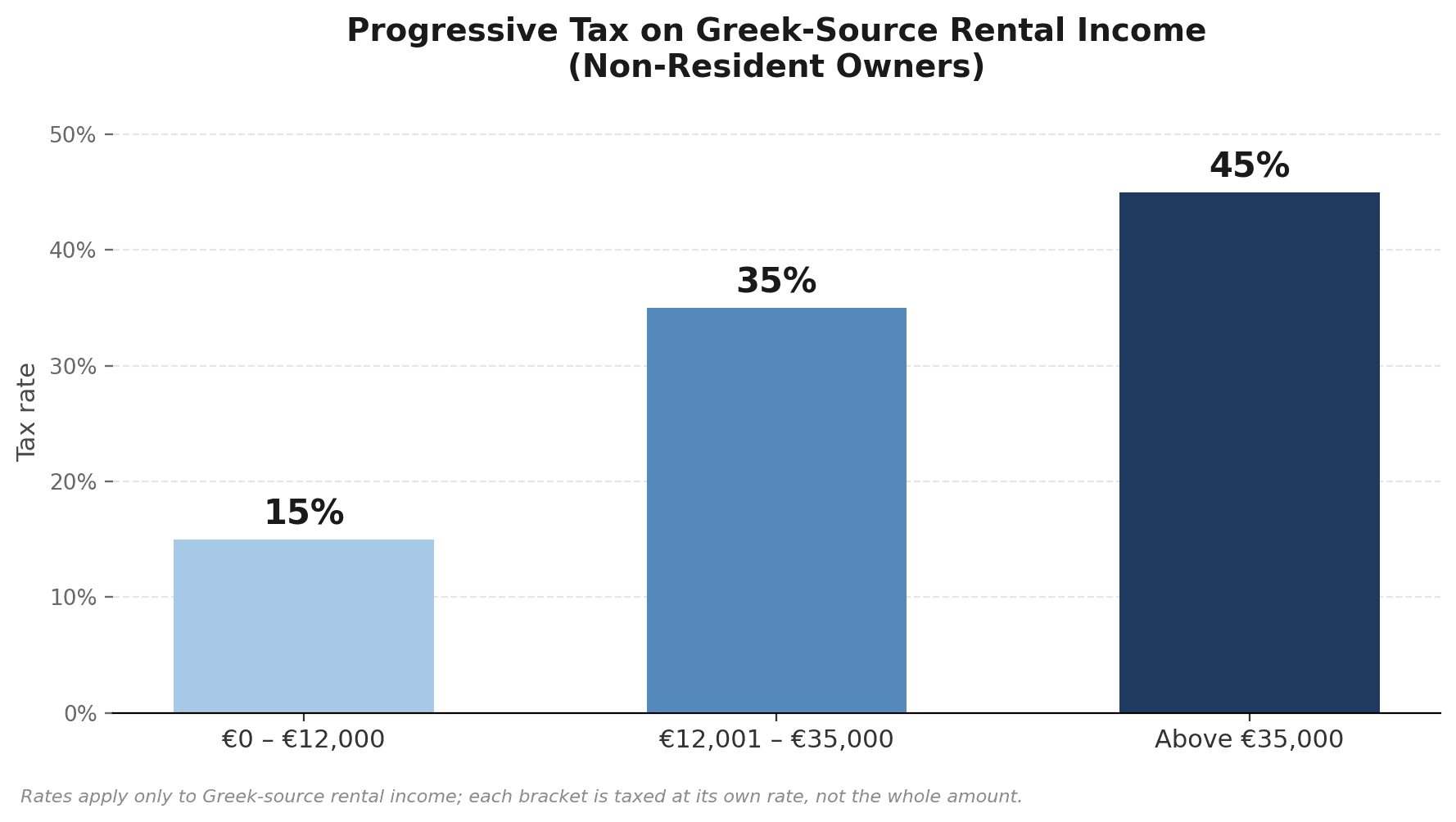
Rental income tax: non-resident owners are taxed only on local-source rental income, at progressive rates of 15% up to €12,000, 35% between €12,001 and €35,000, and 45% above that.
Tax residency: spending fewer than 183 days per year on-site generally keeps an owner's tax residency in their home country, with attractive non-dom regimes available for those who later choose to relocate.
Legal, notary, and registration fees, plus ongoing maintenance, insurance, and any property management costs.
Common Pitfalls to Avoid
Skipping independent legal review. Never rely solely on a developer's or seller's representations — engage your own lawyer to verify legal status, boundaries, and permits.
Misreading the "one property" rule. At the €800,000 and €400,000 tiers, the threshold must be met with a single unit of at least 120 sqm; combining smaller units doesn't qualify, even within the same building.
Choosing the wrong route for short-term rental plans. The conversion pathway explicitly forbids Airbnb-style letting, so it's a poor fit for investors planning short-term income.
Overlooking family documentation. Parents can be included, but dependency must be properly evidenced from the outset to avoid delays.
Assuming the rules are fixed. Investment migration programs remain subject to political and regulatory review, so staying in contact with an advisor helps buyers react to any future policy shifts.
A Realistic Timeline
From the start of a property search to holding the final permit, a straightforward purchase typically takes three to six months, though immigration office backlogs can extend this. Starting the legal and banking steps early is the single best way to keep the process on track.
Working with the Right Team
The biggest challenge for most international buyers isn't finding a property, it's coordinating the legal, tax, and real estate steps correctly and in sequence. A one-stop, English-speaking team that manages sourcing, due diligence, transaction support, and the residency filing itself can significantly reduce friction, particularly for buyers who aren't able to be on the ground throughout the process.
DKG Development supports international clients across this full journey, from initial property selection through to the practical steps of permit execution, offering a single coordinated point of contact rather than a fragmented set of advisors.
Final Thoughts
The program continues to offer a rare combination: a physical asset held in euros, no obligation to relocate, and access to the wider European travel zone. Higher thresholds haven't dampened genuine demand — if anything, they've shifted attention toward well-located, quality properties that hold their value over time. Whether the goal is a European foothold, a future retirement base, or simple portfolio diversification, success ultimately comes down to thorough preparation, independent legal advice, and a clear understanding of the rules as they stand today.