Greece stands at a pivotal moment in its environmental journey. As the country works toward climate neutrality by 2050, every sector must contribute to this national ambition. The real estate and construction industries — historically significant sources of carbon emissions — now have an opportunity to lead rather than lag in this green transition.
At DKG Development, our 2024 Sustainability Report, issued end of year 2025, reflects a clear conviction: building responsibly and growing profitably are not competing objectives. They are, in fact, inseparable.
The Greek Context: Progress Amid Persistent Challenges
According to recent assessments from the European Environment Agency, Greece has made meaningful strides in several environmental areas. Protected land now covers 35% of the national territory, and marine conservation efforts aim to expand protected waters from 18.3% to 30%. Air quality has improved in line with EU emission reduction commitments, and drinking water standards remain excellent.
Yet challenges persist. Circularity rates have declined due to increased material consumption and inefficiencies in waste management. The country remains vulnerable to climate-related threats — from intense heatwaves and prolonged droughts to devastating wildfires and floods. Meanwhile, the energy sector continues to be a primary emissions source, though projections suggest CO2 from energy production could approach zero by 2035.
Within this landscape, the property development sector carries both responsibility and potential. Buildings account for a substantial share of energy consumption and resource use. How developers choose to design, construct, and operate their projects directly influences whether Greece meets its environmental targets — or falls short.
A Year of Measurable Sustainable Progress
For DKG Development, 2024 marked a transition from strategic planning to tangible results. Our formal Environmental, Social, and Governance framework now guides every aspect of our operations, from site selection to material sourcing.
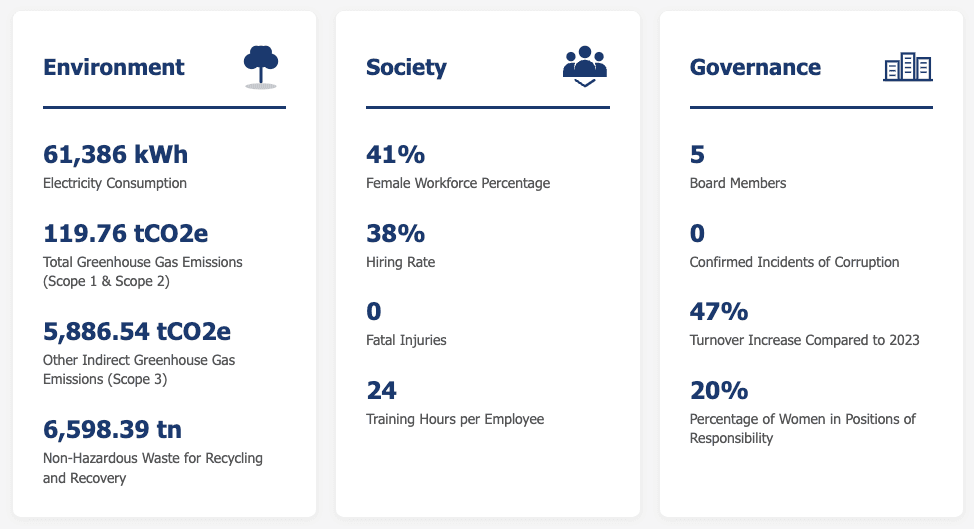
The numbers tell a compelling story. Despite expanding our operational footprint to include all active construction sites, we achieved a 23.1% reduction in emissions intensity compared to the previous year. This means that while our business grew, our environmental efficiency improved significantly — a decoupling of growth from ecological impact that demonstrates what modern, responsible development looks like in practice.
Equally important is our approach to indirect emissions. Recognising that a developer's true carbon footprint extends far beyond its own operations, we mapped over 5,800 tonnes of CO2 equivalent across our supply chain. This transparency enables targeted interventions in procurement and logistics, addressing emissions at their source rather than merely offsetting them after the fact.
Download DKG Development 2024 ESG Full Report
Circularity in an Industry Built on Extraction
The traditional construction model follows a linear path: extract materials, build structures, demolish when obsolete, dispose of waste. This approach is fundamentally incompatible with a sustainable future.
Greece's national Circular Economy Action Plan (2021–2025) acknowledges this reality and sets ambitious targets for waste prevention and resource efficiency. Yet implementation across industries has been uneven, and the construction sector has historically struggled to adopt circular practices at scale.
DKG Development has chosen a different path. In 2024, we diverted 100% of non-hazardous waste from landfills — a zero-waste achievement that directly counters national trends of declining circularity. Nearly 6,600 tonnes of excavation and construction byproducts were channelled toward recycling and material recovery, including over 4,850 tonnes of inert materials and more than 1,740 tonnes of mixed construction debris.
This isn't merely about compliance. It reflects a fundamental shift in how we view construction byproducts: not as waste to be disposed of, but as resources to be recovered and reintegrated.
Innovation in Sustainable Architecture
Beyond operational efficiency, lasting environmental impact comes from the buildings themselves. Our development philosophy now embeds bioclimatic design principles and smart building technologies as standard practice rather than premium add-ons.
We are actively pursuing internationally recognised green building certifications for key projects, ensuring they meet rigorous environmental performance standards. Advanced climate control systems and automated lighting reduce operational energy demand, lowering both the ecological footprint and long-term costs for occupants.
Our urban regeneration strategy prioritises brownfield redevelopment — revitalising existing urban areas rather than expanding into undeveloped land. This approach improves neighbourhood vitality and safety while preserving natural ecosystems and agricultural zones from development pressure.
Social Responsibility in Practice
Environmental stewardship means little without corresponding commitments to social responsibility. A truly sustainable business must also be an ethical employer and a positive community presence.
Our workforce composition reflects these values. Women represent 41% of our team and hold 20% of positions carrying significant responsibility — meaningful progress in an industry where gender imbalance has long been the norm. Rigorous health and safety protocols resulted in zero fatal injuries and zero serious accidents throughout the year.
We also recognise our role in the broader economy. In 2024, our development activities directed over €8.2 million to local suppliers, supporting domestic businesses and contributing to regional economic resilience.
Looking Ahead: A Roadmap to Climate Neutrality
Our journey is far from complete. Looking forward, DKG Development is committed to establishing targets aligned with limiting global warming to 1.5°C. We will continue expanding our emissions mapping to capture additional categories of indirect impact, and we remain dedicated to integrating renewable energy and circular economy principles into every new project.
Greece's path to climate neutrality by 2050 requires collective effort across all sectors. In real estate, this means reimagining how we build, operate, and inhabit our spaces. At DKG Development, we are committed to leading this transformation — constructing not just properties, but a legacy of sustainable progress for generations to come.
Sources: