
Piraeus Gate is one of the largest urban regeneration projects in Greece, a 105,000 sqm. redevelopment delivering more than 1,000 residences and serviced units across 10 buildings in the heart of Piraeus. Designed as a self-sustaining, mixed-use district and developed to achieve and become the first LEED for Neighbourhood Development certification in Greece, it stands among the most ambitious sustainable real estate developments currently underway in the country.
Key Takeaways:
Scale: 105,000 sqm. across 10 buildings with 1,000+ residences and serviced units among Greece's largest urban regeneration projects.
Sustainability: Developed to achieve LEED for Neighbourhood Development (LEED ND) certification, positioning it among the first LEED-certified neighbourhoods in the country.
Operators: Anchored by three international operators — Libere Hospitality Group, IWG, and Smart Rental Group.
Location: Set in central Piraeus, at the heart of Greece's tourism and maritime economy, with construction actively underway.
What is Piraeus Gate
Piraeus Gate is a master-planned urban redevelopment, designed in collaboration with Tsolakis Architects, located in central Piraeus, the principal port city of the Athens metropolitan area and the maritime centre of the country. Spanning 105,000 square metres across 10 buildings, the project integrates residential apartments, serviced apartments, corporate offices, flexible workspace, and ground-floor retail into a single coordinated district.
Rather than a collection of standalone buildings, the project was conceived as a complete neighbourhood with more than 1,000 homes and serviced units, supported by commercial and hospitality space, all developed to a unified sustainability and design standard. Construction is currently underway across several of its buildings, including Skyblue, Skyway, and Piraeus Urban Oasis, each at a different phase of delivery.
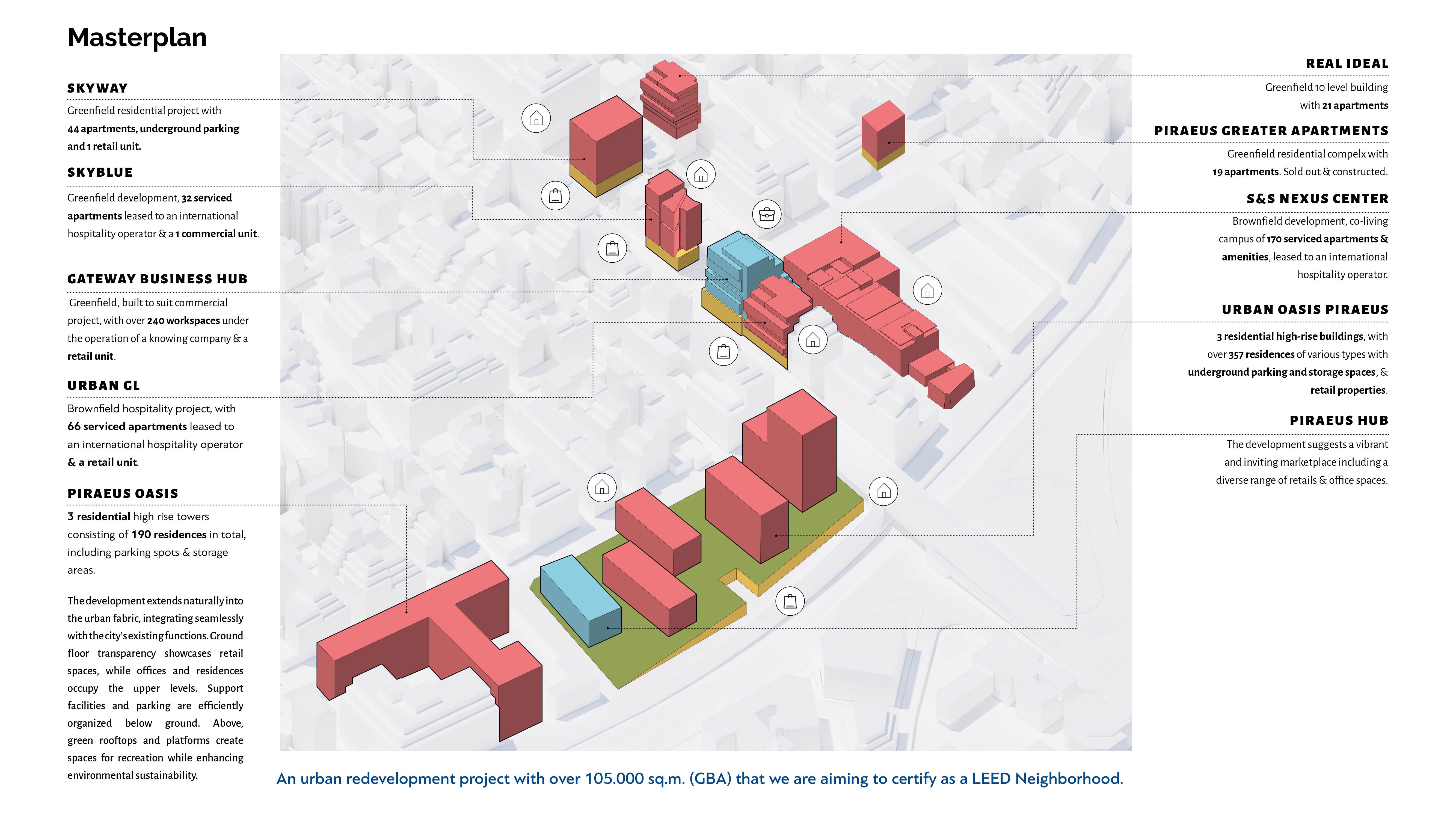
What distinguishes the project is not only its size but its coordination. Many large developments grow piecemeal, building by building, with little relationship between their parts. Piraeus Gate was master-planned from inception as a single integrated district, allowing its residential, commercial, hospitality, and retail components to reinforce one another rather than compete for the same demand. This integrated approach is increasingly the model for serious urban regeneration internationally, and it remains uncommon at this scale in the Greek market.
History of Piraeus
Few development sites in Europe carry the historical weight of the land on which Piraeus Gate now stands.
The story of the area begins in the 5th century BCE, when the Athenian statesman Themistocles chose it as Athens’ primary naval port, a decision that positioned the area at the centre of Mediterranean power for centuries. From the Persian Wars to the Peloponnesian War, this city was the engine of Athenian ambition.
It endured through the Byzantine and Ottoman periods, and emerged again in the 19th century, following Greek independence, as the country’s undisputed hub for shipping and international trade.
It was during this era that the port city earned its remarkable epithet: the “Manchester of the East.” The comparison was not hyperbole. By the late 19th century, the area surrounding what is now Piraeus Gate had become one of Greece’s most concentrated industrial zones, home to the steam mill of N. Stamatopoulos (1873), the textile factories of Ch. Stamatopoulos (1874–1875) and the Retsina brothers, and K.N. Oikonomou’s confectionery factory. Establishments that defined the industrial identity of a city punching well above its weight on the European stage.
The neighbourhood is also inseparable from the legacy of Mimis Traiforos, the celebrated Greek writer and director, whose former residence now serves as the Historical Archive of the Municipality of Piraeus.
A Self-Sustaining Urban Ecosystem
The defining concept behind Piraeus Gate is self-sustaining demand. Large mixed-use projects often carry concentration risk they become too dependent on a single asset class, or on an external source of footfall they cannot control. Piraeus Gate is structured so that each component generates demand for the others.
Residences create long-term resident activity that supports the district's retail and amenities. Offices and flexible workspace anchor weekday economic life and serve the maritime companies headquartered nearby. Serviced apartments capture the steady flow of tourism and business travel moving through the area throughout the year. Ground-floor retail, in turn, is underwritten by all of the above. The result is an urban ecosystem engineered to function as a coherent whole, where the diversity of uses is itself a form of risk management.
Construction is actively progressing across multiple buildings and acquisition financing is available to investors through partner banks. For investors seeking exposure to the country's continuing real estate recovery, the project offers a rare combination: institutional-scale regeneration, international operator partnerships, neighbourhood-level sustainability certification, and a location at the centre of one of the Mediterranean's most strategically significant port cities.
Anchored by Leading International Operators
One of the strongest indicators of a development's commercial fundamentals is who chooses to operate within it. Piraeus Gate is anchored by three of Europe's most established hospitality and workspace operators:
Libere Hospitality Group, one of Europe's fastest-growing serviced apartment operators, managing more than 1,900 units across over 50 properties in Spain, Portugal, Italy, the United Kingdom, and Greece.
IWG, the world's largest flexible workspace operator, with more than 4,000 locations across over 120 countries, and the parent of brands including Regus, Spaces, HQ, and Signature.
Smart Rental Group, a Spanish operator managing more than 3,000 hospitality and living units across Spain, the United Kingdom, Portugal, Hungary, and Greece.
Each of these operators works in a distinct and complementary segment of accommodation and workspace, and each made an independent commercial decision to deploy within Piraeus Gate. That convergence, three international operators arriving at the same conclusion about a single location is an unusually strong signal of confidence in the district's underlying demand.
As the country continues to attract international real estate investment, developments that combine scale, sustainability, and credible execution are positioned to define the next phase of the country's urban growth. The project is among the clearest examples of that direction not a single building, but an entire district being built to the standards the next generation of investors, tenants, and regulators will expect.
Why Piraeus?
The port city is the operating heart of Hellenic tourism and maritime economy. Its port is the country's principal passenger gateway, handling more than 18 million travellers each year, and the surrounding area hosts the headquarters of leading global maritime companies. Karaiskaki Stadium sits roughly 1.3 kilometres from the site, contributing event-driven demand across the football and entertainment calendar, while Metropolitan Hospital, around 1.7 kilometres away, adds a steady healthcare-related catchment.
This concentration of tourism, industry, sport, and healthcare infrastructure creates a structurally diversified base of demand, the foundation on which the mixed-use model of Piraeus Gate is built. Few locations in the country combine so many independent demand drivers within such a compact radius, and it is this combination that allowed international operators to underwrite long-term commitments to the project.
Conclusion
Piraeus Gate represents a new model for urban development in the country. One defined not by the scale of a single building, but by the coherence of an entire district. By combining one of the country's largest regeneration footprints with neighbourhood-level sustainability certification, three internationally established operators, and a location at the centre of the country's tourism and maritime economy, the project sets a benchmark for what large-scale, investment-grade regeneration can look like. As construction advances and the real estate market continues to mature, Piraeus Gate stands as a clear signal of where the country's urban future is heading: integrated, sustainable, and built to endure.