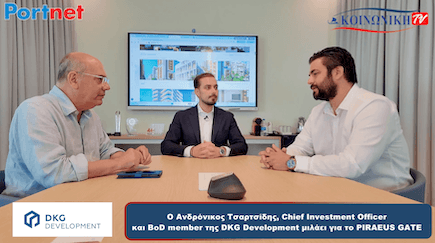
In an extended interview for the Pyxida Enimerosis programme by the newspaper Koinoniki and Portnet, our Board member and Chief Investment Officer Andronikos Tsartsidis set out the thinking behind Piraeus Gate, DKG Development's flagship project at the gateway to the city. Speaking with publisher Apostolos Karamperopoulos and Piraeus journalist Notis Ananiadis — first at our headquarters and then on-site among the works already underway — Tsartsidis described not a single building but the regeneration of a whole neighbourhood, conceived to lift the wider area.
A vision guided by innovation and sustainability
DKG Development's work is guided by two principles: innovation and sustainability. Rather than continue with scattered, one-off developments, the company chose to commit to a single, ambitious project at the entrance to Piraeus — one designed to move in step with the city's emerging identity.
Piraeus, Tsartsidis explained, is one of the most promising areas in Greece right now, with change already visible: new hotel complexes, major companies moving in, and ongoing upgrades to the port. The chosen location — around Grigoriou Lambraki and Omiridou Skylitsi streets — sits in the heart of the city yet has long been hard to access and underdeveloped. Piraeus Gate is intended to bring that neglected pocket back to life.
"We're not building a Dubai"
Throughout the conversation, Tsartsidis returned to a deliberately grounded philosophy. The aim, he stressed, is not to drop striking, futuristic concepts into the city for spectacle's sake, but to respect Piraeus and the people who live there.
"We're not here to build a 'Dubai'. We're here to modernise the neighbourhood and offer it to the people who live in Piraeus — locals who want to raise their quality of life."
That principle runs through the design. The buildings sit within the existing residential fabric rather than towering over it, and the benefits are meant to reach beyond those who buy a home. More than 5,000 m² of green space will be open and accessible to everyone, not only to residents, and the project also includes upgrades to public transport and local infrastructure that the whole community can use. In Greece, Tsartsidis noted, regeneration is often approached as isolated buildings; drawing on examples from abroad, DKG Development treats Piraeus Gate as a single, integrated upgrade — an approach that carries far wider benefits for the local community.
What is being built
Homes are the heart of the project — more than 700 residences in total, conceived as affordable, quality, modern housing rather than oversized luxury apartments. These are not plain apartment blocks: the complexes include shared amenity spaces for residents, reflecting how everyday needs have changed.
Alongside the homes, Piraeus Gate includes offices, ground-floor shops serving the surrounding area, and three serviced-apartment projects. Serviced apartments — a flexible alternative to a hotel — combine private units of varying sizes (not just compact 20–25 m² rooms, but also 40, 60 and 70 m² homes) with shared facilities such as a gym, communal kitchens and coworking spaces, run largely on automated systems. They suit short-stay visitors, longer-staying professionals and teams, and students alike — a significant opportunity given that Greece has one of the highest student populations per capita in Europe but very few purpose-built student rooms, and Piraeus has its own university. These complexes are being entrusted to operators with deep experience managing similar developments across Europe.
Who it's for
Piraeus Gate is aimed at people who will live in the homes themselves and at investors — with the broader goal of bringing well-specified, fairly priced properties to a market under real affordability pressure. As prices have climbed and larger homes have moved out of reach for many, especially younger buyers, DKG has focused on getting the right mix of sizes and typologies.
The early response bears this out: almost 10% of the residences have already been sold, and the buyers are overwhelmingly local — around 95% Greek, of whom roughly 80% are Piraeus residents. Many are people currently living in ageing 1960s–1980s buildings without modern infrastructure such as parking or storage, who are looking to move from quantity to quality — to lower running costs and better energy performance. Keeping the offering reasonably priced is possible, Tsartsidis explained, precisely because DKG acquired a large site, took on the risk of transforming a former industrial area itself, and can therefore keep costs down.
Timeline
The project is being delivered in phases. The first phase — two buildings — is already complete and occupied, mainly by Greek buyers now living there. The second phase is under construction now and is expected to be completed by the end of 2028, with delivery to owners who have already purchased, mostly apartments. The third phase is estimated for completion by the end of 2030. Within roughly five years, the whole of Piraeus Gate — homes, infrastructure and open public spaces — should be delivered and in use.
Closing on-site, Tsartsidis summed up the spirit of the project: reviving a long-inactive neighbourhood and upgrading it into modern homes and more, so that Piraeus residents can enjoy and benefit from it first. In a few months, he added, the first modern properties will be finished — a milestone the team is looking forward to.